
Pentecost week, day 1 · 49 days since Pascha
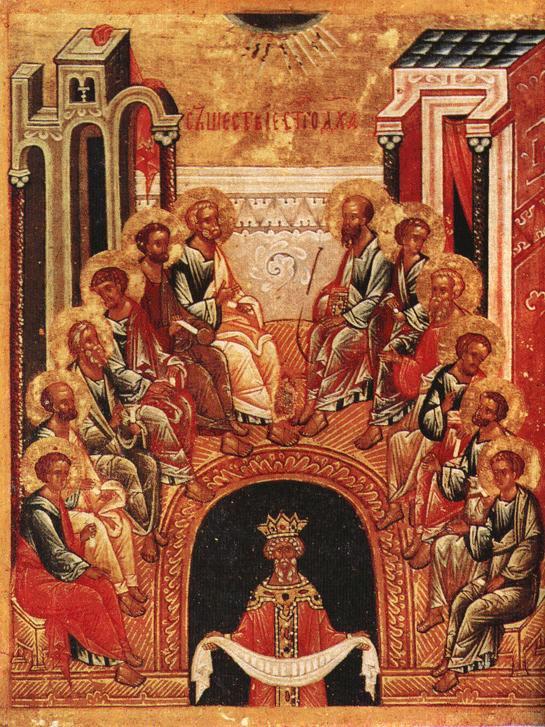
Holy Pentecost

Saints commemorated
-
St Tycho, Bishop of Amathus
-
Holy Martyrs Tigrios and Eutropios (404)
-
Ferreolus and Ferrutio
Ferreolus and Ferrutio — Ferréol and Ferjeux in French — were brothers, a presbyter and a deacon, sent from Lyons to evangelise the Sequani of the upper Doubs and ordained, by the tradition, at the hands of St Irenaeus of Lyons himself. They preached around Besançon for some thirty years, were at length arrested, tortured and beheaded, about the year 212. Their bodies were hidden and forgotten, and were found — so the account runs — in a cave outside the city in 370, when the bishop Anianus enshrined them; the cave and the church built over it are the origin of the two great Besançon dedications that carry their names. They are among the earliest martyrs of eastern Gaul, and their commemoration on June 16 carries a direct line from Smyrna and Polycarp, through Irenaeus, into the forests of the Jura.
-
Five Martyrs of Nicomedia
Five Christians, whose names the tradition has not kept, who were beheaded at Nicomedia in Bithynia and are commemorated together on June 16. Nothing survives of them beyond the bare synaxarial notice that they were martyred by the sword, and a two-line epigram which likens them to a five-towered fortress shaken down by the sword of the executioner. They belong to the long roll of the martyrs of Nicomedia, the eastern imperial capital where the persecutions of Diocletian and Maximian were pressed hardest.
-
Forty Martyrs of Rome
A company of forty martyrs of the city of Rome, unnamed in the tradition, who were burned alive and are commemorated on June 16. The Greek synaxarion gives them a single line — that they were perfected by fire — and a riddling couplet which counts their number out in fives, twenty and twenty, rather than naming it: a memorial in arithmetic for a company whose names were lost. They are among the anonymous Roman companies which the Byzantine calendar received from the martyrologies of the West and kept without further detail.
-
Hermogenes of Tobolsk
Hermogenes (Georgy Yefremovich Dolganev, born 1858) was a lawyer's student turned monk who became rector of the seminary of Tiflis, bishop of Saratov, and — after five years of disgrace for his public war on Rasputin — bishop of Tobolsk in the year of the revolution, while the deposed imperial family was held in that city. Fearless, combative and wholly unwilling to be silent, he denounced the Bolshevik persecution of the Church from his cathedral, was arrested in the spring of 1918, and on the night of 16 June 1918 was drowned in the river Tura with a stone tied about him, near the village of Pokrovskoye. Four men who had gone to plead for him or shared his imprisonment died in the same days: the priests Ephrem Dolganev, Michael Makarov and Peter Korelin, and the layman Constantine Minyatov. All five were glorified by the Russian Church in 2000.
-
Kaikhosro the Georgian
Kaikhosro was a Georgian who was tortured to death by Shah Abbas I in 1612 for refusing to give up the veneration of the holy icons. His memory survives by a narrow thread: the commemoration books and the painted figures of the Monastery of the Holy Cross at Jerusalem — the Georgian house outside the walls of the city — where he was inscribed among the benefactors and the martyrs, and the eighteenth-century researches of Archbishop Timote (Gabashvili), who catalogued what he found there and carried the name into the Georgian tradition. He is commemorated on June 16.
-
Mark of Apollonias
Mark of Apollonias — the apostle of the Seventy whom the New Testament names as "the cousin of Barnabas" (Colossians 4:10) — is counted by the Byzantine tradition among the Seventy and made bishop of Apollonias. He is commemorated on October 30 together with the apostles Tertius, Justus and Artemas of the Seventy, and with all the Seventy on January 4. He is one of the three apostles named Mark whom the synaxaria carefully distinguish — Mark the Evangelist (April 25), Mark "also called John," bishop of Byblos (September 27), and this Mark, bishop of Apollonias — while much of the source tradition, and modern scholarship, tangles the three together.
-
Mnemonios of Amathus
Mnemonios was bishop of Amathus in Cyprus in the second half of the fourth century, the predecessor of Tychon of Amathus, whom he ordained deacon. He is commemorated on June 16, the day of his successor, and everything known of him is contained in that successor's Life: the Greek books state that Mnemonios ordained Tychon to the diaconate and that Tychon was chosen to his see on his death. Nothing else of his life, his deeds or the manner of his repose has come down.
-
Moses of Optina
Moses (Putilov) — Timothy in the world, born at Borisoglebsk in 1782 — was the superior who made Optina what it became. Formed at Sarov, where he knew St Seraphim, and then for ten years among the hermits of the Roslavl forests, heirs of the school of Paisius Velichkovsky, he was brought out of the woods in 1821 by Bishop Philaret of Kaluga to build the skete of St John the Forerunner beside the Optina monastery. From 1825 until his death in 1862 he governed the whole house as superior: he raised its buildings, its library, its lands and its numbers, and — the decisive act — he received the elders Leonid and Macarius, shielded them from the opposition their eldership provoked, and put himself under their direction while remaining their abbot. From that arrangement the Optina eldership grew, and through it a century of Russian religious life. He reposed on 16 June 1862; his relics were found incorrupt, and he was glorified with the Optina elders in 2000.
-
Tigrius and Eutropius
Tigrius, a presbyter, and Eutropius, a reader, of the church of Constantinople, were clergy of John Chrysostom who stood by their archbishop when he was driven from the city in 404 and paid for it with their lives. When the Great Church and the senate house burned on the night of Chrysostom's expulsion, his party — the "Johannites" — were charged with arson; under the city prefect Optatus the two clerics were interrogated and tortured. Eutropius, a young man conspicuous for chastity, was hung up and scraped with iron, thrown into prison, and died in a second session of torture; his body, cast out to the dogs, was recovered by the faithful at night, and the tradition says that angelic singing was heard over the burial. Tigrius, a gentle and open-handed pastor, was scourged, stretched by hands and feet, and banished to Mesopotamia, where he died. They are among the earliest of that company of confessors whose crime was loyalty to a bishop, and their memory is kept on June 16.
-
Tikhon of Amathus
Tychon — Tikhon in the Slavonic and Russian books — was bishop of Amathus on the south coast of Cyprus in the last years of the fourth century and the first quarter of the fifth, and reposed in 425. Born in the city he would afterwards govern, he was known for wonders from boyhood: his Life tells how the bread he gave away out of his father's bakery was repaid with a granary filled to the roof, and how a dry vine-cutting he planted and prayed over took root and bore grapes of extraordinary sweetness, from which wine was pressed for the Eucharist in his lifetime and long after. Reader and deacon under Bishop Mnemonios, he was chosen bishop by the whole city and consecrated by Epiphanius of Cyprus; as hierarch he threw down what was left of the island's idolatry, pulling down the temple at Amathus and turning its people to Christ. He is honoured as a wonderworker throughout the Orthodox world, with a particular cultus in Cyprus, where the village of Agios Tychonas by Limassol still bears his name, and in Russia, where his name passed to a whole line of saints.
-
Tikhon of Kaluga
Tikhon of Medyn and Kaluga (†1492) was a monk of the Chudov monastery in Moscow who left it for the forests of the upper Oka and lived as a hermit in the hollow of a great oak by the little river Vepreika, drinking from a spring he dug himself. Discovered there by Prince Vasily Yaroslavich of Borovsk, whose hunting grounds he had settled on, he was ordered off the land and threatened with the whip — and the raised arm withered on the spot. The prince begged forgiveness, was healed at the saint's prayer, and became the founder's patron: Tikhon built a wooden church of the Dormition of the Theotokos on the site and was first abbot of the community that grew round it, the house known ever since as Tikhonova Pustyn. He reposed in extreme old age in 1492, having received the great schema, and was given all-Russian veneration by the council of 1584. His oak stood for three centuries after him and his well is a place of pilgrimage still.
-
Tikhon of Krestogorsk
Tikhon of Krestogorsk — also called Tikhon of Vokhma — was a monastic of the far north-east of the Vologda country in the second half of the seventeenth century, who in 1679 founded the Krestogorsk hermitage on the river Vokhma, some sixty versts from Nikolsk, at the place called the Cross Hill from which the house took its name. The hermitage was always poor and held almost no land; it was reduced to a parish church in the reforms of 1764, and the parish endured for another eighty-five years. Of the founder himself almost nothing survives beyond the fact of the foundation. He is commemorated on June 16 in the Vologda calendar and in the synaxis of the saints of Vologda; his name is absent from the general Russian menologia, and it is Metropolitan Evgeny (Bolkhovitinov), the compiler of the Vologda hagiography, who secured his place among the saints of that land.
-
Tikhon of Lukhov
Tikhon of Lukhov (†16 June 1503), called Timothy in the world, was a nobleman in military service in the Grand Duchy of Lithuania who in 1482 left his country rather than accept the union with Rome, crossing into Muscovy in the train of Prince Feodor Belsky. He refused the rewards of his new service, gave away what he had, took the habit with the name Tikhon, and settled in the forest of the Lukh country on the border of the Kostroma land. There he lived by the work of his hands — a skilled copyist of books and a turner of wooden vessels — refused ordination to the priesthood out of humility, and formed with two companions, Photius and Gerasim, the community that became the Nikolo-Tikhonov monastery. He died so poor that his disciples had nothing to bury him in until the bishop of Suzdal sent a vestment. His relics were found incorrupt in 1569, and the healings that followed established the veneration of one of the most-loved wonderworkers of the Kostroma and Ivanovo country.
British Isles and Ireland
- St. Cettin, bishop (5th C)
- St. Colman McRoi, abbot of Reachrain (5th C)
- St. Curig, bishop of Llanbadarn (6th C)
- St. Ismael, disciple of St. Teilo (6th C)
Troparia & kontakia
Apolytikion — Tone 8
Blessed art thou, O Christ our God, who hast shown forth the fishermen as all-wise, sending down upon them the Holy Spirit, and through them taking the whole world in thy net. O Lover of mankind, glory to thee.
Apolytikion — Tone 4 (common of martyrs)
Thy martyrs Ferreolus and Ferrutio, O Lord, in their contest received incorruptible crowns from thee our God; for possessing thy strength they cast down the tyrants and shattered the feeble insolence of the demons. By their intercessions save our souls.
Apolytikion — Tone 4 (common of several martyrs)
Thy martyrs, O Lord, in their contest received incorruptible crowns from thee our God; for possessing thy strength they cast down the tyrants and shattered the feeble insolence of the demons. By their intercessions save our souls.
Apolytikion — Tone 4 (common of several martyrs)
Thy martyrs, O Lord, in their contest received incorruptible crowns from thee our God; for possessing thy strength they cast down the tyrants and shattered the feeble insolence of the demons. By their intercessions save our souls.
Apolytikion — Tone 4 (common of a hieromartyr)
As a sharer in the ways and a successor to the thrones of the Apostles, O God-inspired one, thou didst find in contemplation the ascent to divine heights; rightly dividing the word of truth, thou didst contend for the faith even unto blood, O hieromartyr Hermogenes: intercede with Christ God that our souls may be saved.
Apolytikion — Tone 4 (common of a martyr)
Thy martyr Kaikhosro, O Lord, in his contest received an incorruptible crown from thee our God; for possessing thy strength he cast down the tyrants and shattered the feeble insolence of the demons. By his intercessions save our souls.
Apolytikion — Tone 4 (common of a hierarch)
The truth of thy deeds has shown thee to thy flock as a rule of faith, an image of meekness and a teacher of self-restraint; therefore thou hast gained the heights by humility and riches by poverty, O Father and hierarch Mnemonios. Intercede with Christ God that our souls may be saved.
Apolytikion — Tone 4 (common of a monastic saint)
A dweller of the wilderness and an angel in the body wast thou shown to be, O God-bearing Father Moses: by fasting, vigil and prayer thou didst receive heavenly gifts, and thou healest the sick and the souls of them that run to thee with faith. Glory to him who gave thee strength, glory to him who crowned thee, glory to him who works healings through thee for all.
Apolytikion — Tone 4 (common of martyrs)
Thy martyrs, O Lord, in their contest received incorruptible crowns from thee our God; for possessing thy strength they cast down the tyrants and shattered the feeble insolence of the demons. By their intercessions save our souls.
Apolytikion — Tone 4
The truth of thy deeds has shown thee to thy flock as a rule of faith, an image of meekness and a teacher of self-restraint; therefore thou hast gained the heights by humility and riches by poverty, O Father and hierarch Tychon. Intercede with Christ God that our souls may be saved.
Apolytikion — Tone 4 (common of a monastic saint)
A dweller of the wilderness and an angel in the body wast thou shown to be, O God-bearing Father Tikhon: by fasting, vigil and prayer thou didst receive heavenly gifts, and thou healest the sick and the souls of them that run to thee with faith. Glory to him who gave thee strength, glory to him who crowned thee, glory to him who works healings through thee for all.
Apolytikion — Tone 4 (common of a monastic saint)
A dweller of the wilderness and an angel in the body wast thou shown to be, O God-bearing Father Tikhon: by fasting, vigil and prayer thou didst receive heavenly gifts, and thou healest the sick and the souls of them that run to thee with faith. Glory to him who gave thee strength, glory to him who crowned thee, glory to him who works healings through thee for all.
Apolytikion — Tone 4 (common of a monastic saint)
A dweller of the wilderness and an angel in the body wast thou shown to be, O God-bearing Father Tikhon: by fasting, vigil and prayer thou didst receive heavenly gifts, and thou healest the sick and the souls of them that run to thee with faith. Glory to him who gave thee strength, glory to him who crowned thee, glory to him who works healings through thee for all.
Kontakion — Tone 8
When the Most High came down and confounded the tongues, he divided the nations; when he distributed the tongues of fire, he called all men into unity; and with one accord we glorify the all-holy Spirit.
Kontakion — Tone 4
The dead branch took root at thy prayer and gave its wine to the holy Table, O wonderworker Tychon; and thou didst root out the idols from thy city and plant the faith in her. Wherefore we keep thy memory, and glorify Christ who works wonders in his saints.
Megalynarion — Tone 7
O Mother who hast not known man, Virgin Theotokos, who didst conceive without experience of corruption and didst lend flesh to the all-fashioning Word; vessel of him whom nothing can contain, place of thine own uncircumscribed Maker: thee do we magnify.
Oikos
Give swift and steadfast consolation to thy servants, O Jesus, when our spirits grow listless. Be not parted from our souls in afflictions, be not far from our minds in adversities, but come to us always before we call. Draw near to us, draw near, thou who art everywhere; and as thou wast ever with thine apostles, so unite thyself to those who long for thee, O compassionate one, that being joined to thee we may hymn and glorify thine all-holy Spirit.
Troparion — Tone 3
Holy apostles, intercede with the merciful God, that he may grant our souls forgiveness of offences.
Readings
Vespers
Numbers 11.16-17, 24-29
16And the LORD said unto Moses, Gather unto me seventy men of the elders of Israel, whom thou knowest to be the elders of the people, and officers over them; and bring them unto the tabernacle of the congregation, that they may stand there with thee. 17And I will come down and talk with thee there: and I will take of the spirit which is upon thee, and will put it upon them; and they shall bear the burden of the people with thee, that thou bear it not thyself alone. 24And Moses went out, and told the people the words of the LORD, and gathered the seventy men of the elders of the people, and set them round about the tabernacle. 25And the LORD came down in a cloud, and spake unto him, and took of the spirit that was upon him, and gave it unto the seventy elders: and it came to pass, that, when the spirit rested upon them, they prophesied, and did not cease. 26But there remained two of the men in the camp, the name of the one was Eldad, and the name of the other Medad: and the spirit rested upon them; and they were of them that were written, but went not out unto the tabernacle: and they prophesied in the camp. 27And there ran a young man, and told Moses, and said, Eldad and Medad do prophesy in the camp. 28And Joshua the son of Nun, the servant of Moses, one of his young men, answered and said, My lord Moses, forbid them. 29And Moses said unto him, Enviest thou for my sake? would God that all the LORD’s people were prophets, and that the LORD would put his spirit upon them!
Joel 2.23-32
23Be glad then, ye children of Zion, and rejoice in the LORD your God: for he hath given you the former rain moderately, and he will cause to come down for you the rain, the former rain, and the latter rain in the first month. 24And the floors shall be full of wheat, and the fats shall overflow with wine and oil. 25And I will restore to you the years that the locust hath eaten, the cankerworm, and the caterpiller, and the palmerworm, my great army which I sent among you. 26And ye shall eat in plenty, and be satisfied, and praise the name of the LORD your God, that hath dealt wondrously with you: and my people shall never be ashamed. 27And ye shall know that I am in the midst of Israel, and that I am the LORD your God, and none else: and my people shall never be ashamed. 28And it shall come to pass afterward, that I will pour out my spirit upon all flesh; and your sons and your daughters shall prophesy, your old men shall dream dreams, your young men shall see visions: 29And also upon the servants and upon the handmaids in those days will I pour out my spirit. 30And I will shew wonders in the heavens and in the earth, blood, and fire, and pillars of smoke. 31The sun shall be turned into darkness, and the moon into blood, before the great and the terrible day of the LORD come. 32And it shall come to pass, that whosoever shall call on the name of the LORD shall be delivered: for in mount Zion and in Jerusalem shall be deliverance, as the LORD hath said, and in the remnant whom the LORD shall call.
Ezekiel 36.24-28
24For I will take you from among the heathen, and gather you out of all countries, and will bring you into your own land. 25Then will I sprinkle clean water upon you, and ye shall be clean: from all your filthiness, and from all your idols, will I cleanse you. 26A new heart also will I give you, and a new spirit will I put within you: and I will take away the stony heart out of your flesh, and I will give you an heart of flesh. 27And I will put my spirit within you, and cause you to walk in my statutes, and ye shall keep my judgments, and do them. 28And ye shall dwell in the land that I gave to your fathers; and ye shall be my people, and I will be your God.
Matins Gospel
John 20.19-23
19Then the same day at evening, being the first day of the week, when the doors were shut where the disciples were assembled for fear of the Jews, came Jesus and stood in the midst, and saith unto them, Peace be unto you. 20And when he had so said, he shewed unto them his hands and his side. Then were the disciples glad, when they saw the Lord. 21Then said Jesus to them again, Peace be unto you: as my Father hath sent me, even so send I you. 22And when he had said this, he breathed on them, and saith unto them, Receive ye the Holy Ghost: 23Whose soever sins ye remit, they are remitted unto them; and whose soever sins ye retain, they are retained.
Epistle
Acts 2.1-11
1And when the day of Pentecost was fully come, they were all with one accord in one place. 2And suddenly there came a sound from heaven as of a rushing mighty wind, and it filled all the house where they were sitting. 3And there appeared unto them cloven tongues like as of fire, and it sat upon each of them. 4And they were all filled with the Holy Ghost, and began to speak with other tongues, as the Spirit gave them utterance. 5And there were dwelling at Jerusalem Jews, devout men, out of every nation under heaven. 6Now when this was noised abroad, the multitude came together, and were confounded, because that every man heard them speak in his own language. 7And they were all amazed and marvelled, saying one to another, Behold, are not all these which speak Galilæans? 8And how hear we every man in our own tongue, wherein we were born? 9Parthians, and Medes, and Elamites, and the dwellers in Mesopotamia, and in Judæa, and Cappadocia, in Pontus, and Asia, 10Phrygia, and Pamphylia, in Egypt, and in the parts of Libya about Cyrene, and strangers of Rome, Jews and proselytes, 11Cretes and Arabians, we do hear them speak in our tongues the wonderful works of God.
Gospel
John 7.37-52, 8.12
37In the last day, that great day of the feast, Jesus stood and cried, saying, If any man thirst, let him come unto me, and drink. 38He that believeth on me, as the scripture hath said, out of his belly shall flow rivers of living water. 39(But this spake he of the Spirit, which they that believe on him should receive: for the Holy Ghost was not yet given; because that Jesus was not yet glorified.) 40Many of the people therefore, when they heard this saying, said, Of a truth this is the Prophet. 41Others said, This is the Christ. But some said, Shall Christ come out of Galilee? 42Hath not the scripture said, That Christ cometh of the seed of David, and out of the town of Bethlehem, where David was? 43So there was a division among the people because of him. 44And some of them would have taken him; but no man laid hands on him. 45Then came the officers to the chief priests and Pharisees; and they said unto them, Why have ye not brought him? 46The officers answered, Never man spake like this man. 47Then answered them the Pharisees, Are ye also deceived? 48Have any of the rulers or of the Pharisees believed on him? 49But this people who knoweth not the law are cursed. 50Nicodemus saith unto them, (he that came to Jesus by night, being one of them,) 51Doth our law judge any man, before it hear him, and know what he doeth? 52They answered and said unto him, Art thou also of Galilee? Search, and look: for out of Galilee ariseth no prophet. 12Then spake Jesus again unto them, saying, I am the light of the world: he that followeth me shall not walk in darkness, but shall have the light of life.