
Paschaltide, day 1
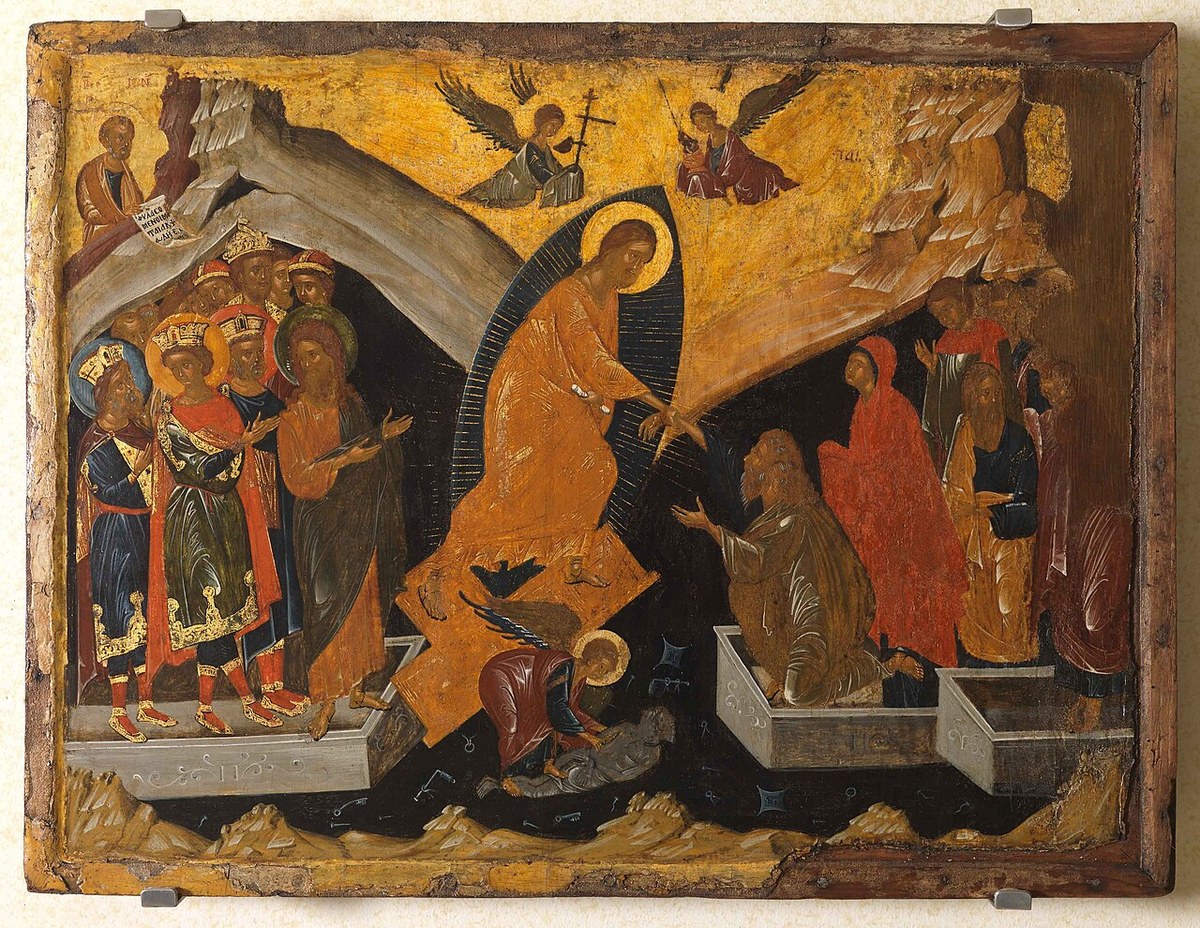
The Resurrection of our Lord and Savior Jesus Christ; Trans. Rel. Boris and Gleb
.jpg)
Saints commemorated
-
Saint of the day
St Athanasius the Great, Patr. of Alexandria
Athanasius the Great (c. 296 – 373) was Archbishop of Alexandria, the champion of the Nicene faith and, with Basil the Great, one of only two Eastern fathers whom the Church styles by universal consent "the Great." Present at the First Ecumenical Council of Nicaea (325) as a young deacon, he became through a long episcopate the tireless defender of the Council's confession that the Son is homoousios — "of one essence" — with the Father, against the Arianism that for two generations captured emperors, courts, and councils. Five times driven from his see and some seventeen years an exile, he held the faith when almost the whole world had gone over to Arius, so that his name became a proverb — Athanasius contra mundum, "Athanasius against the world." He wrote the classic statement of the Incarnation, On the Incarnation of the Word; the Life of Antony, which carried the monastic ideal through the whole Church, East and West; and, in his thirty-ninth Festal Letter of 367, the first listing of the twenty-seven books of the New Testament exactly as the Church now receives them. He died in peace at Alexandria on May 2, 373, having outlived his persecutors and secured the triumph of Orthodoxy. He is kept on January 18 together with Cyril of Alexandria, and on May 2, the day of his repose.
-
Beginning of the Pentecostarion
-
Saint Matrona (the Blind) of Moscow (1952)
-
Holy Martyrs Hesperus, his wife Zoë, and their sons Cyriac and Theodulus (2nd c.)
A whole household of slaves perfected together: Hesperus and his wife Zoe, with their two sons Cyriacus and Theodulus, servants of a rich pagan named Catullus at Attalia in Pamphylia, who suffered about the year 135, in the reign of Hadrian. They had been Christians from childhood and kept themselves from the meat and wine of the idol-sacrifices; when at a birthday feast in their master's house such food was sent down to the slaves, Zoe poured out the wine and threw away the flesh rather than be defiled. The sons were hung upon a tree and torn with iron claws while their parents stood by and encouraged them, and all four were then cast into a heated furnace, where they gave up their souls. Their bodies, the account says, were found untouched by the fire, and singing was heard over them. They are commemorated on May 2.
-
Holy Tsar Boris-Michael of Bulgaria (907)
Boris, prince (knyaz) of the Bulgarians from 852 to 889 and called Michael at his baptism about 864, is the Baptizer of Bulgaria: the ruler who brought a pagan Turkic-Slavic state into the Church, secured for it a church of its own under Constantinople, received the exiled disciples of Cyril and Methodius in 886, and by that act made Bulgaria the nursery of Slavonic letters and the Slavonic liturgy for the whole Orthodox Slavic world. He laid down his power in 889 to become a monk, came out of the monastery once — to depose and blind his own eldest son for attempting to restore paganism — and having set his son Symeon on the throne returned to his cell, where he died on 2 May 907. The Church honours him as equal-to-the-apostles, and his commemoration on May 2 is kept by the Bulgarian, Russian and other Slavic Churches.
-
Translation of the Relics (1072 and 1115) of the Holy Passion-bearers Boris and Gleb, princes of Russia (1015)
Boris and Gleb, sons of Vladimir the Baptizer of Rus' and named Roman and David at the font, were killed in the succession war of 1015 on the orders — so the tradition holds — of their elder brother Svyatopolk, and are honoured as the first canonised saints of the Christian Rus'. Neither died confessing Christ before pagans: both refused to lift a hand against an elder brother and accepted an unjust death in the meekness of the Lord, and for this the Slavic Church gave them a title of its own — passion-bearers (strastoterptsy). Their bodies were gathered at Vyshgorod beside the church of St Basil, where miracles began at once; the translations of their relics into new churches in 1072 and 1115 are kept on May 2, and their murder on July 24. Around them grew the earliest cycle of Russian hagiography — the Chronicle tale, the anonymous Tale and Passion and Encomium, and Nestor's Lesson — and with it the ideal of the innocent, non-resisting prince that shaped the sanctity of Rus' for six centuries.
-
Athanasius Patelarios
Athanasius III Patelarios, a Cretan of the noble Greek house of Patelarios, was three times Patriarch of Constantinople in the harried decades of the mid-seventeenth century, never for long: forty days at his first accession in 1634, fifteen at his last in 1652. Learned in many tongues, a preacher and a translator, he spent most of his life travelling — Athos, Palestine, Thessalonica, Italy, the Danubian principalities — and came at last to Moscow in April 1653, where Tsar Alexis Mikhailovich and Patriarch Nikon received him with honour and where he wrote for the Russians an account of the episcopal Liturgy as it was served in the East. On the journey home he fell ill and died at the Transfiguration monastery of Mgar near Lubny in the Ukrainian land, in 1654. He was buried, in the Greek manner, seated in his chair; in 1662 the grave was opened and the body was found incorrupt and still seated, and he was glorified with his feast on May 2. Russian piety knows him as "Athanasius the Sitting" and as the Wonderworker of Lubny, and his relics rested latterly in the Annunciation Cathedral at Kharkov.
British Isles and Ireland
- St. Neachtain (5th C)
- Hieromartyr St. Germanus (460)
- St. Gluvias, brother of St. Cadoc (6th C)
- St. Ultan, missionary in East Anglia (686)
Troparia & kontakia
Apolytikion
Shining forth in the works of Orthodoxy and quenching every false belief, ye became victors crowned with triumph; enriching all things by your piety and greatly adorning the Church, ye worthily found Christ God, who grants great mercy unto all.
Apolytikion — Tone 4 (common of a hierarch)
O God of our fathers, who ever dealest with us according to Thy gentleness: take not away Thy mercy from us, but by the prayers of Thy hierarch Athanasius guide our life in peace.
Apolytikion — Tone 4 (common of one equal-to-the-apostles)
Having become a partaker of the ways of the Apostles and a teacher of thy people, O Boris named Michael, thou didst lead a whole nation from the darkness of idols to the light of Christ; and laying down thy princely power, thou didst take up the yoke of the monks. Wherefore, O equal of the Apostles, intercede with Christ God that our souls may be saved.
Apolytikion — Tone 4 (common of several martyrs)
Thy martyrs, O Lord, in their contest received incorruptible crowns from Thee our God; for possessing Thy strength they cast down their persecutors and shattered the feeble insolence of the demons. By their prayers, O Christ God, save our souls.
Exapostilarion — Tone 2
Having fallen asleep in the flesh as a mortal man, O King and Lord, on the third day thou didst rise again, raising Adam from corruption and abolishing death: O Pascha of incorruption, O salvation of the world.
Kontakion — Tone 4
Though thou didst descend into the tomb, O Immortal, yet didst thou bring down the power of Hades, and didst rise again as victor, O Christ God, saying to the myrrhbearing women, Rejoice!, and granting peace to thine apostles — thou who dost bestow resurrection on the fallen.
Kontakion — Tone 2
Having planted the doctrines of Orthodoxy, thou didst cut away the thorns of false belief, and didst multiply the seed of the faith by the rain-shower of the Spirit, O venerable one; therefore we hymn thee, O Athanasius.
Kontakion — Tone 3
Today hath your most glorious memory shone forth, O noble passion-bearers of Christ, Roman and David, and it calleth us together to the praise of Christ our God. Therefore, running to the shrine of your relics, we receive the gift of healing by your prayers, O holy ones; for ye are physicians indeed.
Magnification
We magnify you, O holy passion-bearers Boris and Gleb, who loved your brother more than your own life.
Oikos
The maidens bearing myrrh came before the dawn, seeking as men seek the daylight the Sun that was before the sun, who for a while had set within a tomb; and they cried out to one another: O friends, come, let us anoint with spices the life-bearing and buried Body, the flesh that raises up fallen Adam, lying now in the grave. Let us go, let us make haste like the Magi, and worship, and offer our myrrh as gifts to him who is wrapped not in swaddling bands but in a linen shroud; and let us weep and cry aloud: O Master, arise, thou who dost bestow resurrection on the fallen.
The
Christ is risen from the dead, trampling down death by death, and to those in the tombs bestowing life.
The
The women who were with Mary, having come before the dawn and having found the stone rolled away from the tomb, heard from the angel: Why do you seek among the dead, as though he were a man, him who dwells in everlasting light? Behold the grave-clothes! Run and proclaim to the world that the Lord is risen, having put death to death; for he is the Son of God who saves the race of men.
The
It is the day of Resurrection! Let us be radiant, O peoples: Pascha, the Lord's Pascha! For from death to life and from earth to heaven Christ our God has brought us over, as we sing the hymn of victory. Now all is filled with light — heaven, and earth, and the places beneath the earth. Let all creation therefore keep the feast of the rising of Christ, in whom it is made firm. We keep the feast of the putting to death of death, the pulling down of Hades, and the firstfruits of another life, the eternal one; and leaping for joy we hymn the Cause of it, the only blessed and exceedingly glorious God of our fathers. This is the chosen and holy day, the one and first of the sabbaths, the queen and the lady, the feast of feasts and the festival of festivals, on which we bless Christ unto the ages. Shine, shine, O new Jerusalem, for the glory of the Lord has risen upon thee! Dance now and be glad, O Sion; and do thou rejoice, O pure Theotokos, in the rising of him whom thou didst bear. O Pascha, great and most holy, O Christ! O Wisdom and Word and Power of God! Grant us to partake of thee more perfectly in the day of thy kingdom that knows no evening.
The
Today a sacred Pascha has been shown to us: a Pascha new and holy, a Pascha mystical, a Pascha all-venerable, a Pascha that is Christ the Redeemer; a Pascha unblemished, a Pascha great, the Pascha of the faithful, the Pascha that has opened to us the gates of Paradise, the Pascha that sanctifies all the faithful. It is the day of Resurrection! Let us be radiant for the festival, and let us embrace one another. Let us say, O brethren, even to those that hate us: Let us forgive all things for the Resurrection's sake. And so let us cry aloud: Christ is risen from the dead, trampling down death by death, and to those in the tombs bestowing life.
The
Christ, having gone down alone to wrestle with Hades, came up again bearing many spoils of victory.
Troparion — Tone 3
Thou wast made a pillar of Orthodoxy, upholding the Church with divine doctrines, O Hierarch Athanasius; for proclaiming the Son to be of one essence with the Father, thou didst put Arius to shame. O venerable Father, entreat Christ God to grant us great mercy.
Troparion — Tone 2
O true passion-bearers and faithful hearers of the Gospel of Christ, chaste Roman with the most blessed David: ye did not withstand the brother who set himself against you when he slew your bodies, yet had no power to touch your souls. Let the wicked lover of power therefore mourn, while ye rejoice with the angelic choirs; and standing before the Holy Trinity, pray for the sovereign kinsmen of your race, that they may be well-pleasing to God, and for the sons of Rus', that they may be saved.
Readings
Epistle
Acts 1.1-8
1The former treatise have I made, O Theophilus, of all that Jesus began both to do and teach, 2Until the day in which he was taken up, after that he through the Holy Ghost had given commandments unto the apostles whom he had chosen: 3To whom also he shewed himself alive after his passion by many infallible proofs, being seen of them forty days, and speaking of the things pertaining to the kingdom of God: 4And, being assembled together with them, commanded them that they should not depart from Jerusalem, but wait for the promise of the Father, which, saith he, ye have heard of me. 5For John truly baptized with water; but ye shall be baptized with the Holy Ghost not many days hence. 6When they therefore were come together, they asked of him, saying, Lord, wilt thou at this time restore again the kingdom to Israel? 7And he said unto them, It is not for you to know the times or the seasons, which the Father hath put in his own power. 8But ye shall receive power, after that the Holy Ghost is come upon you: and ye shall be witnesses unto me both in Jerusalem, and in all Judæa, and in Samaria, and unto the uttermost part of the earth.
Gospel
John 1.1-17
1In the beginning was the Word, and the Word was with God, and the Word was God. 2The same was in the beginning with God. 3All things were made by him; and without him was not any thing made that was made. 4In him was life; and the life was the light of men. 5And the light shineth in darkness; and the darkness comprehended it not. 6There was a man sent from God, whose name was John. 7The same came for a witness, to bear witness of the Light, that all men through him might believe. 8He was not that Light, but was sent to bear witness of that Light. 9That was the true Light, which lighteth every man that cometh into the world. 10He was in the world, and the world was made by him, and the world knew him not. 11He came unto his own, and his own received him not. 12But as many as received him, to them gave he power to become the sons of God, even to them that believe on his name: 13Which were born, not of blood, nor of the will of the flesh, nor of the will of man, but of God. 14And the Word was made flesh, and dwelt among us, (and we beheld his glory, the glory as of the only begotten of the Father,) full of grace and truth. 15John bare witness of him, and cried, saying, This was he of whom I spake, He that cometh after me is preferred before me: for he was before me. 16And of his fulness have all we received, and grace for grace. 17For the law was given by Moses, but grace and truth came by Jesus Christ.