
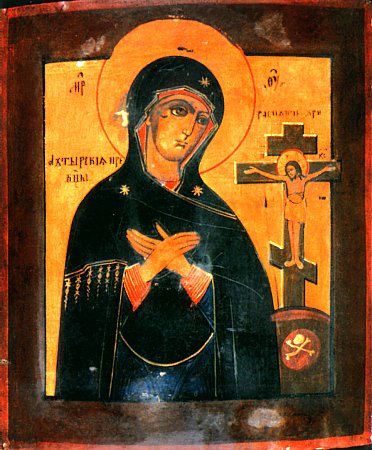
About Akhtyrka Icon of the Mother of God → · About Deposition of the Robe of the Theotokos at Blachernae →

Saints commemorated
-
Saint of the day
Robe of the Theotokos at Blachernae
-
St John (Maximovich), Archbishop of Shanghai and San Francisco (1966) (June 19 OC)
-
St Juvenal, Patriarch of Jerusalem (458)
Juvenal (†458) governed the Church of Jerusalem for some thirty-eight years, from about 422 until his death, and is the hierarch under whom the see of the Holy City ceased to be a bishopric under the metropolitan of Caesarea and became the fifth patriarchate of the Christian world. He stood with Cyril of Alexandria against Nestorius at Ephesus in 431, was among the leaders of the violent assembly of 449, and then at Chalcedon in 451 broke with Dioscorus, subscribed the definition of the two natures, and obtained from the council the three Palestines for his throne — a settlement made by agreement with Maximus of Antioch, at the cost of the Antiochian patriarchate. For his acceptance of Chalcedon the anti-Chalcedonian monks of Palestine drove him from Jerusalem, and he lived some twenty months in exile before imperial troops restored him. He reposed in peace among his flock in 458.
-
St Juvenaly, First Martyr of America and Alaska (1796)
-
Arsenius of Tver
Arsenius (†1409) was Bishop of Tver and the founder of the Zheltikov Monastery of the Dormition on the river Tmaka near that city. Born at Tver, he was tonsured young in the Kiev Caves Monastery, and rose to be archdeacon to Metropolitan Cyprian of Kiev and Moscow, whose administration he helped govern. In 1390, over his own reluctance, he was consecrated bishop of Tver, a see torn by the feuds of its princes; there he laboured as a peacemaker, built churches and his monastery, and had copied for its monks the great manuscript collection later known as the Arsenian redaction of the Kiev Caves Paterikon. He reposed in 1409; his incorrupt relics were uncovered in 1483, and he was canonised by the Moscow Council of 1547. He is commemorated on March 2.
-
Photius of Kiev
Photius (c. 1370s–1431) was a Greek monk of the Peloponnese who was sent from Constantinople in 1408 to be Metropolitan of Kiev and All Rus' and governed the Russian Church for twenty-two years from Moscow. He came to a metropolitanate half-ruined by the wars of Edigu and the Lithuanian pressure on its southern dioceses, and left it richer, better ordered, and canonically one: he recovered the alienated properties of the see, put down the Strigolnik heresy at Pskov and Novgorod, and after ten years of struggle obtained in 1420 the suppression of the rival Lithuanian metropolitanate set up under Gregory Tsamblak. A learned writer of epistles and instructions, he stood as regent-guardian of the boy grand prince Vasily II in the opening of the great Muscovite civil war. He reposed on July 2, 1431, having foreseen his end, and his incorrupt relics were uncovered in the Dormition cathedral of the Kremlin in 1471. He is not the ninth-century patriarch of Constantinople of the same name.
-
Stephen the Great of Moldavia
Stephen the Great (Ștefan cel Mare, c. 1438–1504) ruled Moldavia for forty-seven years, from 1457 until his death on July 2, 1504, and is the central figure of Romanian Orthodox memory: the prince who held the eastern gate of Christendom against the Ottoman advance, and who is said to have built a church for every battle he fought. Under the direction of his spiritual father, the hesychast elder Daniel, he founded or endowed some four dozen monasteries and churches — Putna above all, where he lies buried — and created in the process the Moldavian architectural style. He was canonised by the Romanian Orthodox Church in 1992 and is commemorated on the day of his repose.
British Isles and Ireland
- St. Eddogwy, bishop at Llandaff (c.615)
Troparia & kontakia
Apolytikion — Tone 8 (plagal of the fourth)
O Theotokos ever-virgin, shelter of mankind, thou hast bestowed upon thy city, for a mighty rampart, the Robe and the Girdle of thine undefiled body, which by thy seedless childbearing have remained incorrupt; for in thee both nature and time are made new. Wherefore we entreat thee: grant peace to the world, and to our souls the great mercy.
Apolytikion — Tone 4 (common of a right-believing ruler)
Thou didst rule the people committed to thee in righteousness and in the fear of God, and didst raise up temples to his glory in all thy land; and having guarded the inheritance of the faithful from them that assailed it, thou wast found worthy of a crown that is not of this earth, O right-believing Stephen. Wherefore entreat Christ God that our souls may be saved.
Kontakion — Tone 8
Let us hasten, O faithful, to the gracious fountain of mercies and compassion, the wonderworking image of the most pure Virgin; for it was given us from on high for the salvation of our souls and bodies. Venerating it with love, let us cry aloud to the Theotokos: O Mother hymned of all, O all-merciful Queen, shelter us and keep us from every evil by thy motherly intercession before God.
Kontakion — Tone 4
A garment of incorruption for all the faithful hast thou given, O pure one full of God's grace, even thy sacred Robe, wherewith thou didst cover thy sacred body, O divine shelter of mankind. Its deposition we keep with longing, and we cry aloud in faith: Rejoice, O Virgin, thou boast of Christians.
Kontakion — Tone 2 (common of a hierarch)
Thou wast shown to be a shepherd of the holy city, guiding the flock of Christ by thy teaching; and when the wolves would have scattered it, thou didst suffer banishment for the true confession. Wherefore, O father Juvenal, we cry to thee: cease not to intercede for us all.
Kontakion — Tone 8
By thy life thou wast shown to be a precious vessel of the Trinity, O holy father Photius; and ever beholding the Holy Trinity before whom thou standest, pray without ceasing for us all.
Magnification
We magnify thee, O most holy Virgin, maiden chosen of God, and we honour the precious deposition of thy holy Robe.
Troparion — Tone 4
Most blessed Virgin, pure Mother of God, standing by the Cross of thy Son and our God thou didst endure a great sorrow, and didst receive from him the grace to comfort those that are in sorrow. Therefore, gazing in reverence upon thine all-pure image, and beholding thee portrayed upon it before the Cross of our Saviour, we cry to thee with compunction: O fervent advocate, good and merciful, make haste to deliver us from every sorrow, need and sickness, and save our souls, that we may glorify thee with thanksgiving unto the ages.
Troparion — Tone 4
A rule of faith and an image of gentleness, a teacher of self-restraint, the truth of thy deeds revealed thee to thy flock; and so by lowliness thou didst gain the things on high, and by poverty, riches. O Father and Hierarch Arsenius, intercede with Christ our God that our souls may be saved.
Troparion — Tone 4
O successor upon the hierarchal throne of the Brother of God, praiseworthy hierarch of the holy city of Jerusalem: with the God-wise fathers at Chalcedon thou didst set forth the incarnation of the Son of God, who came to renew the world and to deify all men joined to him in his Church. O holy father Juvenal, who standest now in the kingdom of the Father of lights, pray for those who honour thee with love, that the peace and mercy of the Saviour may be with us.
Troparion — Tone 4
O hearer of the words of the Gospel and lover of the divine teachings, most wise instructor, ever meditating upon the fear of the Lord and reaching out to God in prayer; thou didst stop the mouths of them that wrest the word of the right faith, O sharer in the lot of the Apostles, confirmer of the faith of Christ, utterer of prophecy: O holy father Photius, entreat Christ God to give peace to the world and to save our souls.
Readings
Epistle
Romans 5.17-6.2
17For if by one man’s offence death reigned by one; much more they which receive abundance of grace and of the gift of righteousness shall reign in life by one, Jesus Christ.) 18Therefore as by the offence of one judgment came upon all men to condemnation; even so by the righteousness of one the free gift came upon all men unto justification of life. 19For as by one man’s disobedience many were made sinners, so by the obedience of one shall many be made righteous. 20Moreover the law entered, that the offence might abound. But where sin abounded, grace did much more abound: 21That as sin hath reigned unto death, even so might grace reign through righteousness unto eternal life by Jesus Christ our Lord. 1What shall we say then? Shall we continue in sin, that grace may abound? 2God forbid. How shall we, that are dead to sin, live any longer therein?
Gospel
Matthew 9.14-17
14Then came to him the disciples of John, saying, Why do we and the Pharisees fast oft, but thy disciples fast not? 15And Jesus said unto them, Can the children of the bridechamber mourn, as long as the bridegroom is with them? but the days will come, when the bridegroom shall be taken from them, and then shall they fast. 16No man putteth a piece of new cloth unto an old garment, for that which is put in to fill it up taketh from the garment, and the rent is made worse. 17Neither do men put new wine into old bottles: else the bottles break, and the wine runneth out, and the bottles perish: but they put new wine into new bottles, and both are preserved.