
All Saints
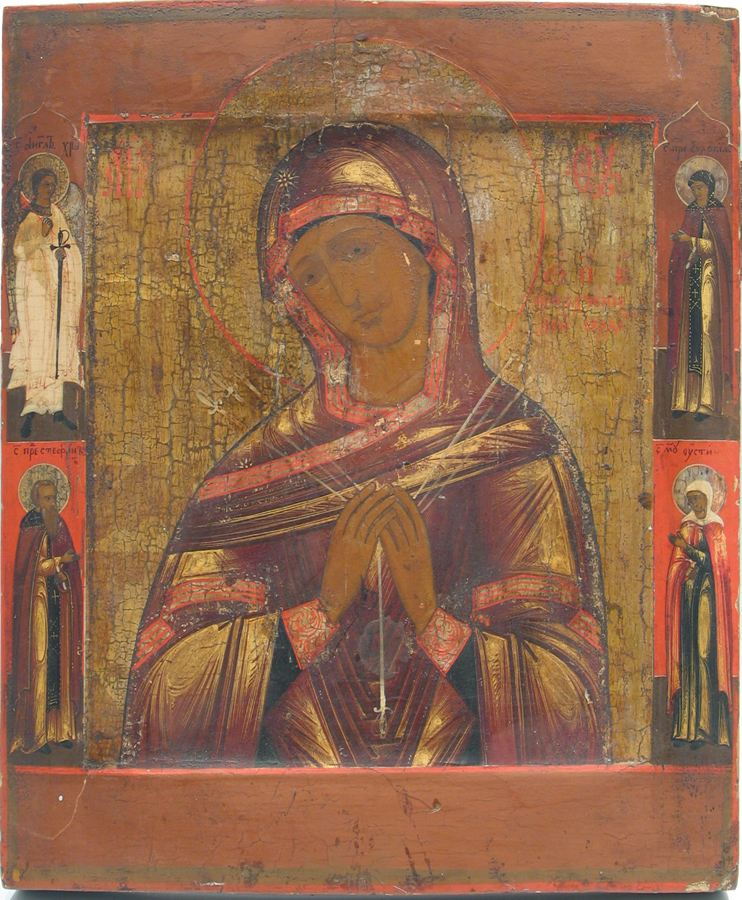
About "Seven Arrows" Icon of the Mother of God → · About Vladimir Icon of the Mother of God →

Saints commemorated
-
Martyr Agrippina of Rome
Agrippina was a Roman virgin of the third century who refused marriage, consecrated herself wholly to Christ, and — in the persecution the Greek acts assign to Valerian (253–259) — presented herself before the tribunal of her own accord and confessed the faith. She was beaten with rods until her bones were broken and bound in chains, from which an angel loosed her, and she died of the injuries. Three Christian women, Bassa, Paula and Agathonike, carried her body out of Rome and by sea to Sicily, where it was laid at Mineo in the interior of the island; there her tomb became one of the great healing shrines of the Sicilian Greeks, and she remains to this day the patroness of the town. She is one of the small group of Roman martyrs whose cultus was carried by relics into the Byzantine world and returned to Rome only as a memory: the Greek Menaia keep her on June 23, and the Sicilian and Italo-Greek tradition keeps her with a festivity older than the Norman conquest of the island.
-
Martyr Agrippina of Rome (3rd c.)
-
Commemoration of the Vladimir Icon of the Most Holy Mother of God
-
Aristocles, Demetrian and Athanasius
Three clerics of the Church of Cyprus — a presbyter, a deacon and a reader — put to death at Salamis about the year 306, in the last and worst of the persecutions. Aristocles was a priest of Tamassos in the copper country of the interior who fled the persecution into a cave on the mountain, was rebuked there by a vision, and came down again to die; on the road he fell in with the deacon Demetrian and the reader Athanasius at the church of the Apostle Barnabas, told them what he had seen, and the two chose to go with him. All three preached openly against the idols in Salamis, were arrested, and were beheaded together. They are among the small number of named Cypriot martyrs of the great persecution, and their memory is kept at Tamassos to this day.
-
Artemius of Verkola
Artemius of Verkola was a peasant boy of twelve from the village of Verkola on the Pinega, in the far north of Russia, who was killed by lightning in a summer thunderstorm on 23 June 1545 while working in the field beside his father. Because a sudden death in a storm was read by his neighbours as a stroke of divine anger, his body was not buried in the churchyard but laid in a pine wood, covered with brushwood and birch bark, and left. Thirty-two years later, in 1577, a light was seen over the place; the body was found incorrupt, was carried into the church of St Nicholas at Verkola, and at once became the centre of an extraordinary series of healings during an epidemic that was then wasting the Pinega. A monastery grew up at the spot. He is one of the very few saints of the Russian Church glorified neither for martyrdom nor for asceticism nor for office, but simply as a righteous child, and he is a patron of children and of the Russian North.
-
Etheldreda of Ely
Etheldreda — Æthelthryth in her own tongue, Audrey in the mouths of later Englishmen — was a princess of the royal house of East Anglia who passed through two marriages without surrendering the virginity she had vowed, was for twelve years queen of Northumbria, and at last obtained her husband's leave to take the veil. In 673 she founded the double monastery of Ely on the island in the fens that had come to her as a marriage gift, and ruled it as abbess with a severity she imposed first on herself: one meal a day, wool rather than linen, and prayer from the night office until daybreak. She died on 23 June 679 of a tumour in the neck, which she received as the just penalty for the necklaces of her girlhood. Sixteen years later her sister Seaxburh raised her body and found it incorrupt, the surgeon's incision healed to a scar. Bede, who tells her story at length and adds a hymn of his own composition in her honour, made her the most celebrated of Anglo-Saxon women saints; Ely remained her city, and her name survives, by an odd descent, in the English word tawdry.
-
Eustochius, Gaius and their Companions of Ancyra
A converted pagan priest and the household of his own kinsman, put to death at Ancyra in Galatia in the last of the great persecutions. Eustochius had served the idols; watching the Christians die, and seeing the wonders worked at their martyrdoms, he came over to the faith, was baptised by Eudoxius, bishop of Antioch, and was ordained presbyter. Preaching afterwards at Lystra in Lycaonia, he brought his nephew Gaius and Gaius's whole household to Christ — among them Probus, Lollius and Urban. Denounced and arrested, they were sent under guard to the governor Agrippinus at Ancyra, tortured together without distinction of age or sex, and at last beheaded. Their memory is kept on June 23, the day of the martyr Agrippina, and the synaxarion notice is all that survives of them.
-
Herman of Kazan
Herman of Kazan (sixteenth century, died 1567) was a monk of the school of Joseph of Volokolamsk who became the first abbot of the Dormition monastery of Sviyazhsk and, from 1564, the second archbishop of the newly Christian region of Kazan. A learned copyist of books and a builder of churches and monastic libraries, he laboured to enlighten the Muslim and heathen peoples of the middle Volga. Summoned by Ivan the Terrible in 1566 to be metropolitan of Moscow, he dared to rebuke the Tsar's cruelties, was cast into disgrace, and died at Moscow on November 6, 1567. His relics were later enshrined at Sviyazhsk, and his repose is his principal feast.
-
Nicetas of Thebes
Nicetas was a monk of Thebes in Boeotia, the "seven-gated" city of the old Greek epic, who was tonsured at the age of sixteen and gathered about him a small company of ascetics — the monks Daniel, Theodore and Gregory are the three the synaxarion names — drawn by the report of his character rather than by any office he held. He received the gift of wonderworking, and, as the notice puts it, the hospitality of Abraham: the charism of receiving whoever came and sending them away rested in soul. He lived to a great age and reposed in 1079. The record of him is a single synaxarion notice and one anecdote of a journey to Patras; he belongs to that large class of Byzantine ascetics of the middle period whose sanctity was local, unliterary, and nonetheless kept in the books of the Church.
-
Theodore of Rostov and Suzdal
Theodore, a Greek by birth, was consecrated in 991 or 992 — within a few years of the baptism of Rus' — as the first bishop of Rostov, and so the first hierarch sent into the wholly pagan forest country of the upper Volga and the Kliazma. The Merya and Slav population of Rostov would not receive him and drove him out; he withdrew to Suzdal, where his preaching took root, and there he baptised and taught until his repose in 1023. He is honoured as the founder of the see that Leontius, Isaiah and Ignatius afterwards made famous, as the enlightener of the Suzdal land, and — because his body was found incorrupt — as a wonderworker. His relics rest in the Cathedral of the Nativity of the Theotokos at Suzdal.
British Isles and Ireland
- St. Mochaoi, abbot of Nendrum (498)
Troparia & kontakia
Apolytikion — Tone 4
Thy lamb, O Jesus, cries aloud: O my Bridegroom, thee I long for, and contending I am crucified and buried with thee in thy baptism; I suffer for thy sake, that I may reign with thee; I die for thee, that I may live in thee. Receive me as a spotless offering, for I am slain in love of thee. By her prayers, O merciful one, save our souls.
Apolytikion — Tone 4
Thy martyrs, O Lord, in their contest received incorruptible crowns from Thee, our God; for possessing Thy strength, they cast down the tyrants and shattered the feeble insolence of the demons. By their intercessions save our souls.
Apolytikion — Tone 8
In thee, O mother, was the divine image preserved with exactness; for taking up the cross, thou didst follow Christ, and by thy deeds thou didst teach us to despise the flesh, for it passes away, and to care rather for the soul, a thing immortal. Wherefore, O venerable Etheldreda, thy spirit rejoices with the angels.
Apolytikion — Tone 4
Thy martyrs, O Lord, in their contest received the crown of incorruption from thee our God; for possessing thy strength they cast down the tyrants and shattered the feeble insolence of the demons. By their prayers, O Christ God, save our souls.
Apolytikion — Tone 8
In thee, O father, was the divine image preserved with exactness; for taking up the cross, thou didst follow Christ, and by thy deeds thou didst teach us to despise the flesh, for it passes away, and to care rather for the soul, a thing immortal. Wherefore, O venerable Nicetas, thy spirit rejoices with the angels.
Kontakion — Tone 8
Seven swords pierced thy soul, O Virgin, when thou didst stand beneath the Cross of thy Son; and now thou standest for us before him, healing by thy wounds the hardness of our hearts. Wherefore we cry: rejoice, thou that art wounded for our sake.
Kontakion — Tone 8
To thee, our Champion Leader, we ascribe the prizes of victory, for we have been delivered from evils by the coming of thine honoured image, O Lady Theotokos; and we keep with gladness the festival of thy Meeting, and cry to thee as we have been taught: Rejoice, O Bride unwedded.
Kontakion — Tone 4
Thou didst spurn an earthly bridegroom and keep thy virginity unspotted for Christ, and being broken with rods thou wast not broken in soul, O all-honoured Agrippina; wherefore thy relics, borne over the sea, pour out healing upon the faithful who cry: Rejoice, O boast of Rome and shelter of the island.
Kontakion — Tone 8
As a pure and unblemished offering thou wast brought to the Lord in thy twelfth year, and the thunder that struck thee down was to thee the chariot of thine ascent; and now, O righteous Artemius, standing before the throne with the choirs of children, thou pourest out healings upon the sick who run to thy shrine, that we may cry to thee: Rejoice, O boast of the northern land.
Kontakion — Tone 2
A king's daughter and a king's wife, thou didst keep thy virginity unspoiled in the midst of the palace, and didst exchange the crown of Northumbria for the veil; and founding thy monastery in the fen, thou wast made a mother of many daughters. Wherefore the Lord glorified thy body with incorruption, O righteous Etheldreda; entreat him that our souls may be saved.
Kontakion — Tone 2
A priest of idols didst thou become a priest of Christ, O wise Eustochius, taught by the blood of the martyrs; and thou didst bring to the Lord thy kinsman with all his house, a whole company for an offering. Wherefore, having contended together and been beheaded together, ye stand together before the throne, entreating mercy for us all.
Kontakion — Tone 4
Illumining with the excellences of holiness and righteousness the reason-endowed flock entrusted to thee, and nourishing it in the verdant pastures of the word of Christ, thou didst by the power of thy spirit guide it into the right path of the Lord's commandments; wherefore now also, overshadowed by thy healing wonders, on thy holy memory we cry out to thee: Rejoice, O Herman our father.
Kontakion — Tone 2
From thy sixteenth year thou didst take on thee the yoke of Christ, O father Nicetas, and the seven-gated city sent thee forth as a lamp to the ascetics; and having received the hospitality of Abraham, thou didst give rest to all who came to thee. Wherefore we cry: entreat unceasingly for us all.
Kontakion — Tone 4
Sent as the first shepherd into a land that knew not Christ, thou wast driven from Rostov and didst not turn back, but at Suzdal thou didst raise up a people to God; wherefore thy body was kept incorrupt, O hierarch Theodore, and we bless thy first labours in the north.
Synaxarion
The fire spared the deacon and the reader; one sword took all three, and gave them one crown.
Troparion — Tone 4
Soften our evil hearts, O Mother of God, and quench the assaults of those that hate us, and loose every straitness of our soul; for beholding thy holy image we are pierced with compunction at thy suffering and thy tender mercy toward us, and we kiss thy wounds, and are afraid of the arrows of our own sins. Suffer us not, O Mother of compassion, to perish in our cruelty and from the cruelty of our neighbours.
Troparion — Tone 4
Today the most glorious city of Moscow is arrayed in gladness, having received thy wonderworking icon, O Sovereign Lady, as the dawning of the sun; and now, running to it and praying, we cry to thee: O all-wondrous Lady Theotokos, entreat Christ our God, who was made flesh of thee, that he preserve this city and all the cities and lands of the Christians unharmed from every device of the enemy, and save our souls, for he is merciful.
Troparion — Tone 2
By the command of the Most High thou wast taken from the earth in thy childhood, O blessed Artemius, and wast borne up in innocence to the mansions of heaven; and thy body, laid unhonoured in the wood, God glorified with incorruption and with wonders. Wherefore the land of the Pinega, once ashamed of thee, now rejoices in thee: entreat Christ our God that our souls may be saved.
Troparion — Tone 4
Having zealously taken up the yoke of Christ from thy youth, thou wast glorified by the wakeful labours of fasting and prayer; wherefore, when God called thee to the service of the Church in the newly-enlightened realm of Kazan, thou wast summoned together with the hierarch Gurias, and there wast shown to be the first founder of the monastery thou didst raise in the city of Sviyazhsk and a worthy successor of the first hierarch. Standing in spirit before the throne of the Master, pray, O hierarch Herman, together with the hierarch Gurias, that the Orthodox flock may grow in piety and that the darkness of false belief may be scattered by the light of the faith.
Troparion — Tone 4 (common of a hierarch)
O guide of Orthodoxy, teacher of piety and holiness, luminary of the whole world, God-inspired adornment of hierarchs: by thy teachings thou hast enlightened all, O harp of the Spirit. O righteous father Theodore, intercede with Christ our God that our souls may be saved.
Readings
Vespers
Isaiah 43.9-14
9Let all the nations be gathered together, and let the people be assembled: who among them can declare this, and shew us former things? let them bring forth their witnesses, that they may be justified: or let them hear, and say, It is truth. 10Ye are my witnesses, saith the LORD, and my servant whom I have chosen: that ye may know and believe me, and understand that I am he: before me there was no God formed, neither shall there be after me. 11I, even I, am the LORD; and beside me there is no saviour. 12I have declared, and have saved, and I have shewed, when there was no strange god among you: therefore ye are my witnesses, saith the LORD, that I am God. 13Yea, before the day was I am he; and there is none that can deliver out of my hand: I will work, and who shall let it? 14Thus saith the LORD, your redeemer, the Holy One of Israel; For your sake I have sent to Babylon, and have brought down all their nobles, and the Chaldeans, whose cry is in the ships.
Wisdom of Solomon 3.1-9
1But the souls of the righteous are in the hand of God, and there shall no torment touch them. 2In the sight of the unwise they seemed to die: and their departure is taken for misery, 3And their going from us to be utter destruction: but they are in peace. 4For though they be punished in the sight of men, yet is their hope full of immortality. 5And having been a little chastised, they shall be greatly rewarded: for God proved them, and found them worthy for himself. 6As gold in the furnace hath he tried them, and received them as a burnt offering. 7And in the time of their visitation they shall shine, and run to and fro like sparks among the stubble. 8They shall judge the nations, and have dominion over the people, and their Lord shall reign for ever. 9They that put their trust in him shall understand the truth: and such as be faithful in love shall abide with him: for grace and mercy is to his saints, and he hath care for his elect.
Wisdom of Solomon 5.15-6.3
15But the righteous live for evermore; their reward also is with the Lord, and the care of them is with the most High. 16Therefore shall they receive a glorious kingdom, and a beautiful crown from the Lord’s hand: for with his right hand shall he cover them, and with his arm shall he protect them. 17He shall take to him his jealousy for complete armour, and make the creature his weapon for the revenge of his enemies. 18He shall put on righteousness as a breastplate, and true judgment instead of an helmet. 19He shall take holiness for an invincible shield. 20His severe wrath shall he sharpen for a sword, and the world shall fight with him against the unwise. 21Then shall the right aiming thunderbolts go abroad; and from the clouds, as from a well drawn bow, shall they fly to the mark. 22And hailstones full of wrath shall be cast as out of a stone bow, and the water of the sea shall rage against them, and the floods shall cruelly drown them. 23Yea, a mighty wind shall stand up against them, and like a storm shall blow them away: thus iniquity shall lay waste the whole earth, and ill dealing shall overthrow the thrones of the mighty. 1Hear therefore, O ye kings, and understand; learn, ye that be judges of the ends of the earth. 2Give ear, ye that rule the people, and glory in the multitude of nations. 3For power is given you of the Lord, and sovereignty from the Highest, who shall try your works, and search out your counsels.
1st Matins Gospel
Matthew 28.16-20
16Then the eleven disciples went away into Galilee, into a mountain where Jesus had appointed them. 17And when they saw him, they worshipped him: but some doubted. 18And Jesus came and spake unto them, saying, All power is given unto me in heaven and in earth. 19Go ye therefore, and teach all nations, baptizing them in the name of the Father, and of the Son, and of the Holy Ghost: 20Teaching them to observe all things whatsoever I have commanded you: and, lo, I am with you alway, even unto the end of the world. Amen.
Epistle
Hebrews 11.33-12.2
33Who through faith subdued kingdoms, wrought righteousness, obtained promises, stopped the mouths of lions, 34Quenched the violence of fire, escaped the edge of the sword, out of weakness were made strong, waxed valiant in fight, turned to flight the armies of the aliens. 35Women received their dead raised to life again: and others were tortured, not accepting deliverance; that they might obtain a better resurrection: 36And others had trial of cruel mockings and scourgings, yea, moreover of bonds and imprisonment: 37They were stoned, they were sawn asunder, were tempted, were slain with the sword: they wandered about in sheepskins and goatskins; being destitute, afflicted, tormented; 38(Of whom the world was not worthy:) they wandered in deserts, and in mountains, and in dens and caves of the earth. 39And these all, having obtained a good report through faith, received not the promise: 40God having provided some better thing for us, that they without us should not be made perfect. 1Wherefore seeing we also are compassed about with so great a cloud of witnesses, let us lay aside every weight, and the sin which doth so easily beset us, and let us run with patience the race that is set before us, 2Looking unto Jesus the author and finisher of our faith; who for the joy that was set before him endured the cross, despising the shame, and is set down at the right hand of the throne of God.
Gospel
Matthew 10.32-33, 37-38, 19.27-30
32Whosoever therefore shall confess me before men, him will I confess also before my Father which is in heaven. 33But whosoever shall deny me before men, him will I also deny before my Father which is in heaven. 37He that loveth father or mother more than me is not worthy of me: and he that loveth son or daughter more than me is not worthy of me. 38And he that taketh not his cross, and followeth after me, is not worthy of me. 27Then answered Peter and said unto him, Behold, we have forsaken all, and followed thee; what shall we have therefore? 28And Jesus said unto them, Verily I say unto you, That ye which have followed me, in the regeneration when the Son of man shall sit in the throne of his glory, ye also shall sit upon twelve thrones, judging the twelve tribes of Israel. 29And every one that hath forsaken houses, or brethren, or sisters, or father, or mother, or wife, or children, or lands, for my name’s sake, shall receive an hundredfold, and shall inherit everlasting life. 30But many that are first shall be last; and the last shall be first.