
Joasaph of Moscow
Our Father among the Saints Joasaph (Skripitsyn), Metropolitan of Moscow and All Rus'
Bishop · Venerable · d. 1555
Commemorated 27 July — Repose at the Trinity-Sergius monastery
Joasaph (Skripitsyn), Metropolitan of Moscow and All Rus' from 1539 to 1542, was hegumen of the Trinity-Sergius monastery, godfather at the baptism of the future Ivan the Terrible, and one of the few men of the boyar regency who tried to use the primatial office to restrain the factions rather than to profit by them. He obtained the release of Prince Ivan Belsky from prison, and for that was overthrown in a night coup by the Shuiskys on 3 January 1542, hunted through the Kremlin, and exiled to the Kirillo-Belozersky monastery. Allowed back after Ivan's coronation, he returned to Trinity-Sergius and lived out his last years there among his books, reposing on 27 July 1555. He is credited with the Life of Serapion of Novgorod and with obtaining the release of Maximus the Greek from confinement. His relics lie under a bushel in the Serapion chamber of the Trinity cathedral.

Hegumen of the Trinity
Nothing certain is known of Joasaph's birth or family; the surname Skripitsyn attaches to him in the later sources. The first fact that can be dated is that in 1529 he was raised from among the elders of the Trinity-Sergius monastery — the house of Sergius of Radonezh, and the moral centre of Muscovy — to be its hegumen.
In 1530 he stood as godfather at the font for the son of Grand Prince Vasily III: the child was baptised at the Trinity, at the tomb of St Sergius, and grew up to be Ivan IV. That single act of sponsorship placed the abbot of the Trinity inside the dynasty's own household, and explains a good deal of what followed.
Metropolitan in the regency
Vasily III died in 1533 and his widow Elena Glinskaya in 1538, leaving a child of eight on the throne and the great boyar houses — Shuisky, Belsky, Glinsky — fighting over him. In this vacuum Metropolitan Daniel, who had been Vasily's man, was forced out, and on 6 February 1539 Joasaph was taken from the Trinity and set on the metropolitan throne of Moscow.
He did not stay out of the fight, and he did not pretend to. In 1540 he petitioned the boy sovereign for the release of Prince Ivan Belsky from prison, and got it; from that point he and Belsky were together the "first counsellors" of the young Ivan, and the Shuisky faction regarded the metropolitan as an enemy of their control of the palace.
The night of 3 January 1542
They struck at night. Armed men came for the metropolitan; Joasaph fled first to the sovereign's own chambers, and, when the mob broke in there, out of the Kremlin to the Trinity monastery, stones flying after him. The chronicles record that the hegumen of the Trinity had to physically shield him from being killed at Sergius's tomb. He was deposed and sent under guard to the Kirillo-Belozersky monastery on the White Lake, the standard place of confinement for men whom Moscow wished to forget; Macarius of Novgorod was brought in to succeed him.
The episode is not a footnote. It is the first time the Muscovite primacy was broken by a palace faction by force, and it set the pattern that would run through the metropolitanate of Philip a generation later.
The years at the Trinity
After Ivan's coronation in 1547 Joasaph was allowed to leave Beloozero and return to the Trinity-Sergius monastery, where he lived as a simple monk for his last eight years. He was, by the standards of Muscovy, a genuine scholar: a collector and copyist of books, several of which survive with his ownership marks, and the traditional author of the Life of Archbishop Serapion of Novgorod. He is also credited with securing the release of Maximus the Greek from the imprisonment in which the Russian church had held him for a quarter of a century — a debt the learning of Muscovy owed him and did not always acknowledge. From his retirement he sent written answers to the questions of the Stoglav council of 1551.
He reposed on 27 July 1555 and was buried in the southern porch of the Trinity cathedral — the Serapion chamber, beside the archbishop whose life he had written. The relics rest there under a bushel; their place was identified again during restoration work at the Lavra in 2006.
Canonisation
Local veneration at the Trinity was old, but the formal steps are modern: Joasaph was entered in the Synaxis of the Radonezh Saints in 1981, in the Synaxis of the Moscow Saints in 1997, and was canonised for veneration by the whole Russian Church by the Bishops' Council of 3 February 2016. His day is the day of his repose.
Feast and commemoration
July 27 (church date; New Calendar civil July 27, Old Calendar civil August 9), the day of his repose. Russian and OCA usage; he is not in the Greek books. He is also commemorated within the Synaxis of the Radonezh Saints (July 6) and the Synaxis of the Moscow Saints (movable, the Sunday before 26 August), and at the Trinity-Sergius Lavra among its own fathers. On the fixed day his memory is kept alongside Panteleimon, whose office fills it.
Hymns
Apolytikion — Tone 4 (common of a hierarch)
A rule of faith and an icon of gentleness, a teacher of self-restraint: so did the truth of things show thee to thy flock. Therefore hast thou gained by lowliness the things on high, and riches by poverty. O father and hierarch Joasaph, intercede with Christ our God, that our souls may be saved.
Iconography
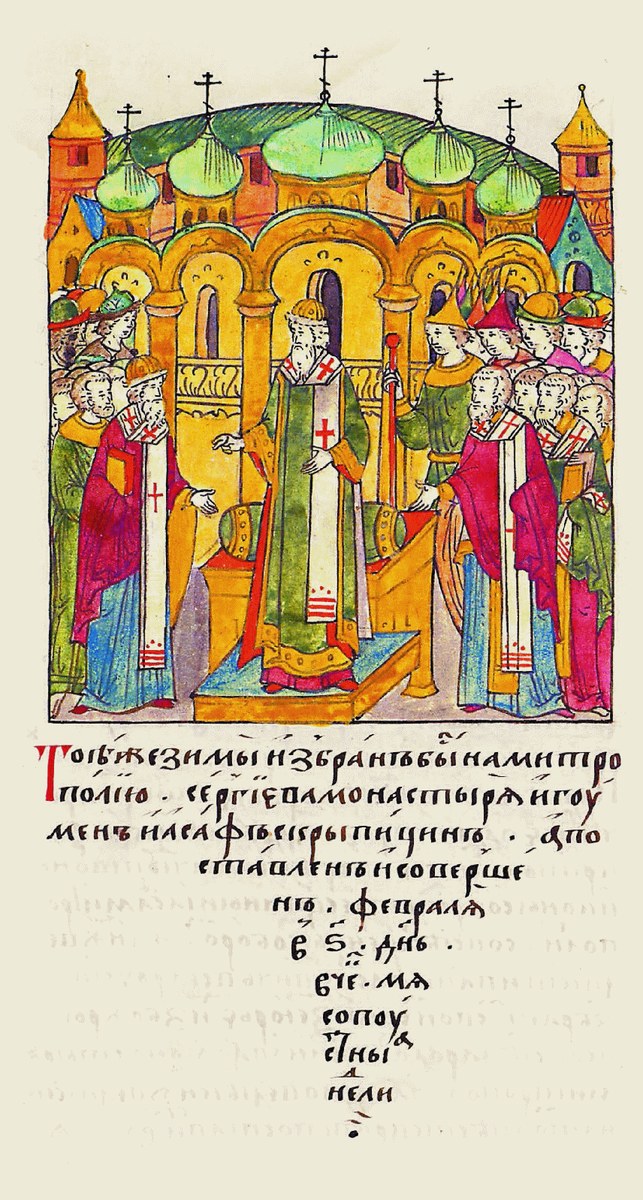
Joasaph is painted as a Russian metropolitan of the sixteenth century: in the white klobuk of the Moscow primates, the sakkos or the polystaurion phelonion and the omophorion, blessing with the right hand and holding the Gospel; the beard is long, grey and narrow. Because his cult is largely of the last forty years, almost all painted images of him are modern, and they place him either in the rank of the Radonezh saints around Sergius or in that of the Moscow hierarchs. The one near-contemporary depiction is not an icon at all but a miniature in the Illustrated Chronicle Codex (Litsevoi letopisnyi svod) of the 1570s, showing the installation of the hegumen Joasaph as metropolitan of Moscow and All Rus'.
No pre-1900 icon of him has been located for this collection, and this is a consequence of the history: his general canonisation dates only from 2016, and the images produced since are living iconographers' copyrighted work.
The stored image is the miniature of the Illustrated Chronicle of Ivan the Terrible (16th century) for his election, the folio's caption naming "the hegumen of the Sergius monastery Ioasaf Skrypitsyn, chosen for the metropolitanate… consecrated the 6th day of February."
Disputed questions
- Authorship of the Life of Serapion. The attribution is traditional and probable, not documented; some scholars assign the text to the Trinity scriptorium generally.
- The release of Maximus the Greek. Joasaph's part is well attested in the Trinity tradition; how much of the improvement in Maximus's condition was his doing and how much belonged to his successor Macarius is disputed.
- Not to be confused with Joasaph of Belgorod (†1754, September 10 and December 10), the far better-known Russian hierarch of the name, nor with the several Joasaphs of the Russian monastic calendar.