
Polycarp of the Kiev Caves
Our Venerable Father Polycarp, Archimandrite of the Kiev Caves Lavra
Venerable · d. 24 July 1182
Commemorated 24 July — Repose at the Kiev Caves Lavra, 1182
Polycarp was archimandrite of the Caves monastery at Kiev in the second half of the twelfth century, in the generation after the founders, and reposed there on 24 July 1182. He had been formed in the monastery under the guidance of his kinsman Simon, afterwards bishop of Vladimir and Suzdal, and was chosen superior by the brotherhood on the death of the igumen Akindinus. Under him the Caves house stood at the height of its authority: he was confessor and adviser to the princes of Kiev as well as to his monks, and it was to him that the Great Prince Rostislav confided his desire to lay down the crown and be tonsured — a desire Polycarp discouraged, telling him that God had set him where he was to do justice, and which death overtook before it could be fulfilled. His name means "much fruit," and the tradition has always played upon it: he is remembered as the archimandrite under whom the memory of the Caves fathers was gathered and written down, and the printed Paterikon shows him at his desk composing their lives.

The Caves in the twelfth century
Polycarp's origins are not recorded. He entered the monastery of the Caves — founded a century before by Antony and organised by Theodosius, and by his day the mother-house of Russian monasticism — and was tonsured there. His guide in the ascetic life was his kinsman Simon, a monk of the Caves who was afterwards raised to the see of Vladimir and Suzdal; the relationship matters, because it is the same Simon whose letters to a monk named Polycarp stand at the head of the Kiev Caves Paterikon. Under Simon's direction he learned, in the language of the tradition, the two things the Caves existed to teach: the acquisition of the virtues and the labour of repentance.
By the middle of the century the Caves monastery had received the dignity of a lavra with an archimandrite at its head — the senior monastic rank in the Rus' church, which set its superior above the igumens of the other houses of Kiev. On the death of the igumen Akindinus, the brotherhood elected Polycarp, and he governed the house until his death. The chronicles show the archimandrite of the Caves in these years as a public figure of the principality: the monastery received princes, buried them, and arbitrated among them, and its superior was the confessor of the ruling house.
Rostislav of Kiev
The one episode of his abbacy preserved at length concerns the Great Prince Rostislav Mstislavich (†1167), a devout ruler who kept the custom of coming to the Caves in Great Lent and who took Polycarp as his spiritual father. Rostislav conceived the wish to end his life as a monk, and pressed Polycarp to tonsure him. Polycarp refused, and his refusal is the most characteristic thing recorded of him: God, he told the prince, had appointed him to his place in the world, and what was required of him there was to do justice, keep peace among his kinsmen, and defend those who could not defend themselves — that was his monasticism. Rostislav did not give up the intention; he provided that the schema should be given him at the last, and asked to be buried in the Caves. He fell ill on the road from Novgorod and died at Zarub in 1167 before the vow could be carried out, and was buried at his sister's foundation at Kiev instead. The Caves tradition kept the story as an example of discernment, not of severity: the superior who would not let a prince buy the easier road.
Repose and successor
Polycarp died on 24 July 1182. The account of what followed is one of the most vivid passages in the Caves record. The brotherhood could not agree on a successor, and — the Great Prince Svyatoslav being present in the monastery — they gave themselves to prayer before the relics of the founders and before the wonderworking icon of the Dormition, and asked to be shown the man. The name given them was that of a priest of a village church named Basil, who was living outside the monastery altogether. He resisted, protesting that he was no monk; the brethren persuaded him, he was tonsured, and he was made igumen — the house having gone, in one election, from an archimandrite of long standing to a parish priest chosen by lot of prayer. Polycarp was buried in the caves, and is numbered in the synaxis of the fathers there.
Polycarp the writer
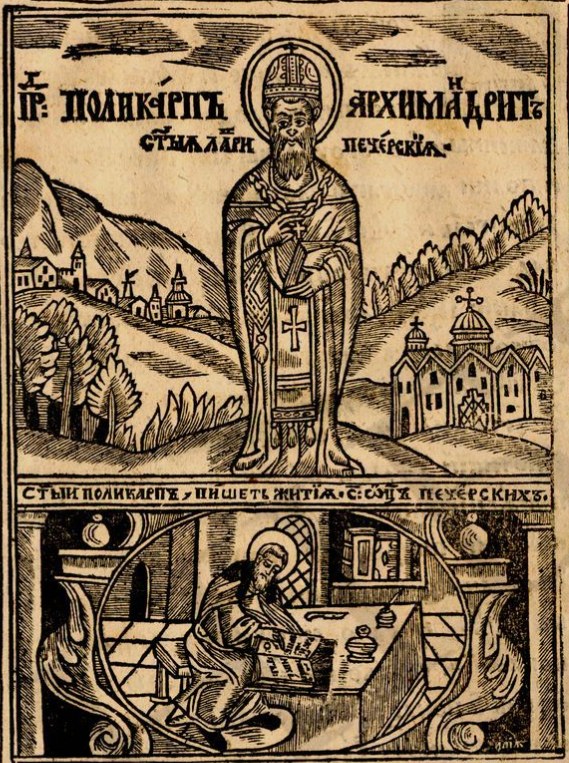
To Polycarp the tradition also assigns a place in Russian letters. The Kiev Caves Paterikon, the collection of the lives and sayings of the fathers of the monastery which is one of the founding books of Slavic literature, is built out of two twelfth- and thirteenth-century cores: the letter and lives sent by Bishop Simon to a monk Polycarp, and the answering set of lives written by that Polycarp and addressed to the archimandrite Akindinus. Russian and Ukrainian usage has traditionally identified the recipient and author of these letters with this archimandrite of the Caves, and calls him for that reason Polycarp the Hagiologist; the 1661 Lavra woodcut reproduced below shows him twice on one sheet, standing in the archimandrite's vestments above and seated below at his writing-desk, with the legend "St Polycarp writes the lives of the holy fathers of the Caves." The identification is very old and is the one the liturgical books assume, but it is not secure (see Disputed questions).
Feast and commemoration
July 24 (church date; Old Calendar civil August 6), the day of his repose. He is commemorated in the Russian, Ukrainian and OCA calendars, and is named in the synaxis of the fathers of the Kiev Caves. The Greek and Antiochian books do not carry him. He shares the day in Slavonic usage with Boris and Gleb, whose service takes the office, and with the great martyr Christina of Tyre; his own commemoration is of the simplest rank, a troparion and a synaxarion notice within their day.
Hymns
Troparion — Tone 8 (common of a venerable father)
In thee, O father, was preserved undistorted that which is according to the image; for taking up the cross thou didst follow Christ, and by thy deeds thou didst teach us to despise the flesh, for it passeth away, but to care for the soul, a thing immortal. Wherefore, O venerable Polycarp, thy spirit rejoiceth with the angels.
Original translation from the Slavonic
Kontakion — Tone 2
Bearing in thy very name the promise of much fruit, thou didst bring it forth in the caves of Kiev, O father Polycarp: ruling the brotherhood in meekness, counselling princes in righteousness, and setting down in writing the labours of the fathers before thee. Wherefore, having finished thy course in the house thou didst serve, thou dost pray for us who honour thee.
Original translation from the Slavonic
Iconography
Polycarp is painted as a monastic elder of the great schema, grey- or white-bearded, in the dark mantle and koukoulion, and — because he was an archimandrite — sometimes in the epitrachelion and epimanikia with the cross or the Gospel, and occasionally with the abbot's staff. In the Caves cycles he takes his place among the ranked fathers of the monastery on the great composite icons of the Sobor of the Near and Far Caves, where each father stands in a tier holding a scroll and is identified only by his inscription. As the supposed author of the Paterikon he is also given a scroll or an open book, and the narrative type shows him writing at a desk — an attribute he shares with Nestor the Chronicler, and one which asserts the disputed literary identification rather than reporting the abbacy.
The stored image is a woodcut from the 1661 Kiev-Caves Paterikon, the first printed edition of the book, issued by the Lavra press. The sheet is divided: above, the saint stands full-length in the archimandrite's vestments between the hills of Kiev, blessing and holding a book, with the churches of the monastery behind him and the Church Slavonic inscription "Ven. Polycarp, Archimandrite of the Holy Lavra of the Caves"; below, in a cartouche, he is shown seated in his cell before a window, a book open on the desk and the inkhorn beside him, under the legend "St Polycarp writes the lives of the holy fathers of the Caves." The engraving is well out of copyright and the reproduction is a flat, faithful one, so it is stored under pd-old-work. It should be read with the caution stated above: the lower half of the sheet is a seventeenth-century assertion of the authorship question, not evidence for it.
Disputed questions
- One Polycarp or two? The difficulty is chronological. The archimandrite died in 1182, and was elected on the death of an igumen Akindinus; but the Polycarp of the Paterikon letters writes to an archimandrite Akindinus, and the Akindinus who held that office is dated by most scholarship to the 1220s. Either there were two superiors of the name Akindinus, a generation apart — which the Caves lists in fact allow — or the writer Polycarp is a later monk of the same house and name, of the early thirteenth century, distinct from the archimandrite commemorated on July 24. The bulk of modern Russian and Ukrainian scholarship takes the second view and treats the hagiographer as a thirteenth-century monk, aggrieved at not being made a bishop, to whom Simon's admonitory letter is addressed. The liturgical tradition, the Lavra's own seventeenth-century printed Paterikon, and the OCA life keep the older identification. This entry records the commemorated saint as the archimandrite of 1182 and reports the literary attribution as tradition rather than as fact.
- Near Caves or Far Caves? The OCA heads his life Archimandrite of the Kiev Far Caves; other Russian sources place his relics in the Near Caves among the fathers buried there. The two sets of caves have their own synaxes (28 September for the Near, 28 August for the Far), and the discrepancy affects which of those synaxes he is counted in. It is not resolved here.
- The date of his election. The chronicles do not give it directly. He is generally reckoned to have governed from about 1164, on the death of the first Akindinus, to 1182 — some eighteen years — but the figure is inferred rather than recorded.