
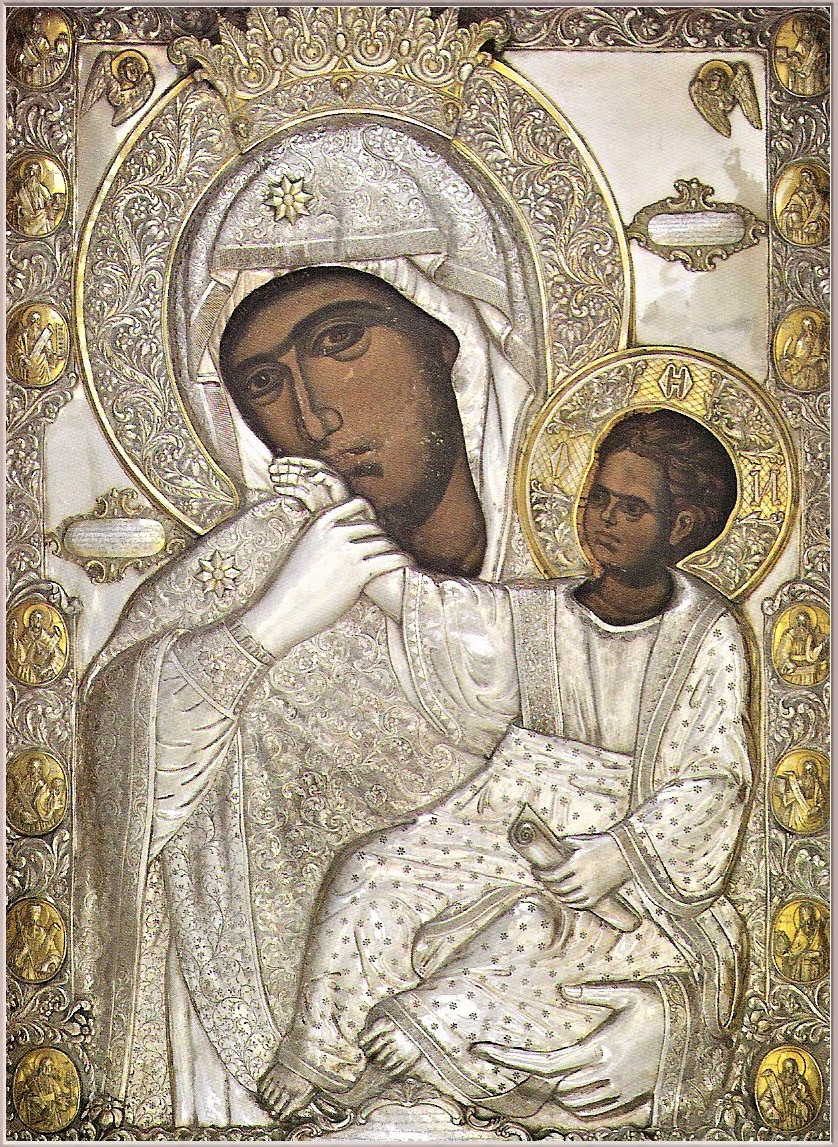
About The "Paramythia" (Consolation) Icon of the Mother of God →

Saints commemorated
-
Saint of the day
Ven. Maximus the Confessor
Maximus the Confessor (c. 580 – 662) is the supreme theologian of the seventh century and one of the greatest fathers of the Church. A high official at the court of the emperor Heraclius who left the world for the monastic life, he became the tireless defender of the full humanity of Christ against Monotheletism — the imperial doctrine that the incarnate Word had but one (divine) will and one operation — insisting that because Christ is truly God and truly man he possesses two natural wills and two natural energies, human and divine, the human freely and always conformed to the divine. In the Ambigua, the Questions to Thalassius, and the Mystagogy he drew the Chalcedonian and Cyrilline inheritance into a single cosmic vision of creation, incarnation, and deification. For refusing communion with the heresy — and for the Lateran Council of 649, which condemned it — he and his disciples were tried at Constantinople, and, when he would not yield, his tongue and right hand were cut off so that he could neither speak nor write the truth; he was exiled to Lazica in the Caucasus, where he died on 13 August 662. Twenty years later the Sixth Ecumenical Council (680–81) vindicated his theology as the faith of the Church. His principal feast is January 21; August 13 keeps his repose and the translation of his relics.
-
Saint of the day
Maximus the Greek
Maximus the Greek (c. 1470 – 1556) was an Athonite scholar-monk sent from Vatopedi to Muscovite Russia as a translator, who became one of the most learned men of his age and a confessor imprisoned for decades. Born Michael Trivolis at Arta in Epirus and educated in Renaissance Italy — Florence, Venice, Padua — he returned to Orthodoxy and became a monk on Mount Athos. Summoned to Moscow in 1516 to translate and correct the Slavonic service-books and Scriptures, he laid the foundations of Russian humanist learning; but his rebukes of injustice and avarice, his links to the "non-possessor" party, and errors seized upon from his corrections brought him, at councils of 1525 and 1531, condemnation on charges of heresy, sorcery, and treason. He was imprisoned in the monasteries of Volokolamsk and Tver for more than twenty years, cut off for long stretches from the sacraments, yet never ceased to write. Released at the last to the Trinity–St Sergius Lavra, he reposed there on January 21, 1556, and was glorified by the Russian Church in 1988.
-
Holy Martyr Agnes of Rome (ca. 304)
Agnes of Rome (c. 291 – c. 304) is one of the most celebrated virgin-martyrs of the undivided Church, a girl of about twelve or thirteen who gave her life at Rome in the Great Persecution rather than betray her consecrated virginity or deny Christ. Born of a noble Christian family and sought in marriage by the son of the city prefect, she answered that she had already a Bridegroom, Christ, whom she would not forsake; denounced as a Christian, she was subjected to shame and threat — exposed, the tradition says, in a house of ill fame, where her hair grew to veil her and an angelic light shielded her, and where those who assailed her were struck down. Neither seduction, nor terror, nor fire could move her; she was at last slain by the sword. Venerated at once at her tomb on the Via Nomentana, over which a basilica rose, she is kept on January 21, and her name — near the Latin agnus, a lamb — made her the very emblem of innocence.
-
Our Holy Father Maximos the Greek (1556)
-
Anastasius the Monk and Anastasius the Apocrisiarius
Anastasius the Monk (†662) and Anastasius the Apocrisiarius (†666) were the two disciples of Maximus the Confessor who shared his struggle against Monotheletism, his trials at Constantinople, and his sufferings. Anastasius the Monk was Maximus's longtime cell-attendant and companion; Anastasius the Apocrisiarius was a Roman, the apocrisiarius (legate) of the Church of Rome. With their master, both refused communion with the one-will heresy; both had their tongues cut out and their right hands cut off, and both were exiled to the barbarous land of Lazica in the Caucasus, where they died confessors — the Monk soon after Maximus in 662, the Apocrisiarius, longest-lived of the three, in the fortress of exile in 666. They are commemorated together with Maximus on January 21.
-
Eugene, Candidus, Valerian and Aquila
Eugene, Candidus, Valerian and Aquila were four Christians of Trebizond on the Black Sea coast of Pontus, martyred in the persecution of Diocletian about the year 303–305. Hiding from the persecutors in the hills near the city, Candidus, Valerian and Aquila were seized first and, after cruel scourging, imprisoned; Eugene, coming forward to confess Christ and — the tradition says — overthrowing the idol of Mithras that the pagans of Trebizond revered, was arrested and joined to them, and all four were tortured and at last beheaded. Of the four, Eugene became the great patron saint of Trebizond, honoured by the city and, in later centuries, by the emperors of the Grand Komnenoi, whose coins bore his image; a church was raised over his relics, and his memory is kept on January 21.
-
Neophytus of Nicaea
Neophytus of Nicaea (†c. 303–305) was a boy-martyr of Bithynia whom the tradition remembers for the gift of wonderworking bestowed on him while he was still a child. Born at Nicaea of devout Christian parents, he was said to have worked miracles from his earliest years — the tradition tells of a dove that spoke to him, of water drawn from a rock, and of his foreknowledge of his mother's death. Withdrawing while still a boy to a cave on Mount Olympus in Bithynia, from which he first drove and then tamed a lion, he came down at the outbreak of the Great Persecution to confess Christ before the persecutors. Though barely fifteen, he endured scourging, fire, and the beasts unharmed, and was at last slain by the sword (or the spear). He is kept on January 21.
British Isles and Ireland
- St. Brigid of Kilbride (6th C)
- St. Wynnin, bishop and abbot of Holywood (6th C)
- St. Lawdog of Wales (6th C)
- St. Macallan, hermit and abbot (978)
Troparia & kontakia
Kontakion — Tone 8
Let us the faithful worthily praise the lover of the Trinity, great Maximus, who taught clearly the God-inspired faith — to glorify Christ in two natures, with twofold energies and wills alike — and let us cry aloud to him: Rejoice, O herald of the Faith.
Troparion — Tone 4 (common of a virgin-martyr)
Thy lamb Agnes crieth out to thee, O Jesus, with a great voice: I love thee, my Bridegroom, and in seeking thee I endure the contest; I am crucified and buried with thee in thy baptism, and I suffer for thy sake, that I may reign with thee; I die for thee, that I may live in thee. Accept me as a spotless sacrifice, offered in love to thee. By her prayers, O merciful One, save our souls.
Troparion — Tone 4 (common of martyrs)
Thy martyrs, O Lord, in their contests received incorruptible crowns from thee, our God; for possessing thy strength, they cast down the tyrants and broke the feeble insolence of the demons. By their prayers, O Christ God, save our souls.
Troparion — Tone 8
O guide of Orthodoxy, teacher of piety and holiness, luminary of the Church, God-inspired adornment of monastics, O wise Maximus: by thy teachings thou hast enlightened all, O lyre of the Spirit. Intercede with Christ our God, that our souls may be saved.
Troparion — Tone 4 (common of a martyr)
Thy martyr Neophytus, O Lord, in his contest received the incorruptible crown from thee, our God; for possessing thy strength, he cast down the tyrants and broke the feeble insolence of the demons. By his prayers, O Christ God, save our souls.
Readings
Epistle
Hebrews 7.1-6
1For this Melchisedec, king of Salem, priest of the most high God, who met Abraham returning from the slaughter of the kings, and blessed him; 2To whom also Abraham gave a tenth part of all; first being by interpretation King of righteousness, and after that also King of Salem, which is, King of peace; 3Without father, without mother, without descent, having neither beginning of days, nor end of life; but made like unto the Son of God; abideth a priest continually. 4Now consider how great this man was, unto whom even the patriarch Abraham gave the tenth of the spoils. 5And verily they that are of the sons of Levi, who receive the office of the priesthood, have a commandment to take tithes of the people according to the law, that is, of their brethren, though they come out of the loins of Abraham: 6But he whose descent is not counted from them received tithes of Abraham, and blessed him that had the promises.
Gospel
Luke 21.28-33
28And when these things begin to come to pass, then look up, and lift up your heads; for your redemption draweth nigh. 29And he spake to them a parable; Behold the fig tree, and all the trees; 30When they now shoot forth, ye see and know of your own selves that summer is now nigh at hand. 31So likewise ye, when ye see these things come to pass, know ye that the kingdom of God is nigh at hand. 32Verily I say unto you, This generation shall not pass away, till all be fulfilled. 33Heaven and earth shall pass away: but my words shall not pass away.