
All Saints
About "Seven Arrows" Icon of the Mother of God →
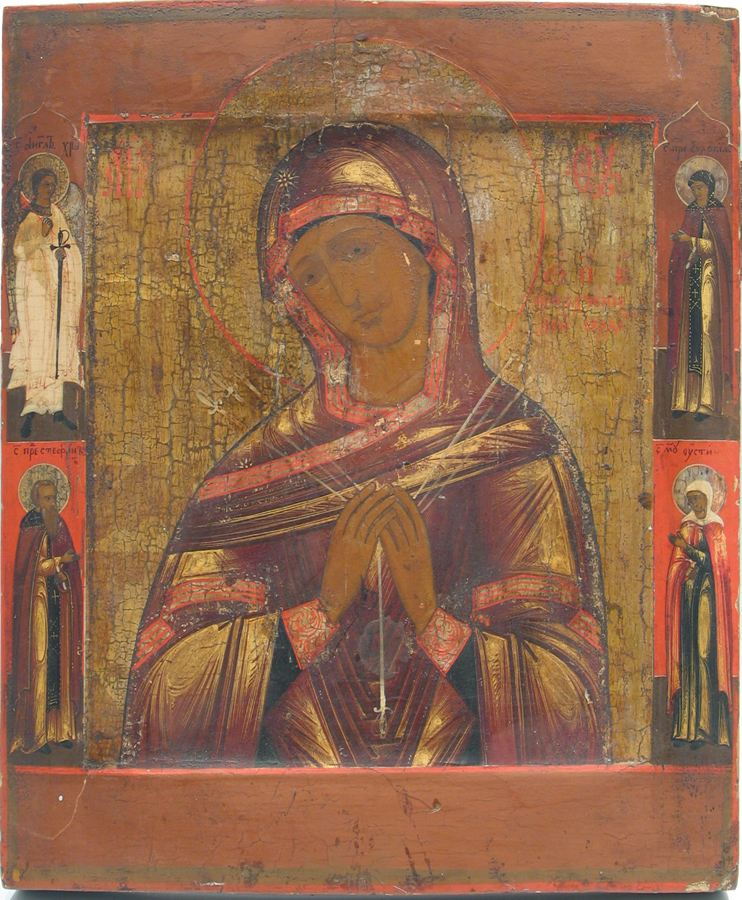

Saints commemorated
-
Prophet Amos
Amos (8th century BC) was a herdsman and dresser of sycamore figs from Tekoa in the Judaean hill-country who was taken from behind his flock and sent north, into the rival kingdom of Israel, to prophesy against its wealth, its shrines and its cruelty to the poor. He was the first of the prophets whose words were gathered into a book, and the sharpest: he denounced the selling of the righteous for silver and the poor for a pair of sandals, the beds of ivory and the summer houses, and the crowded festivals of Bethel that God, he said, hated and would not smell — demanding instead that judgement roll down like waters, and righteousness like an unfailing torrent. Expelled from the royal sanctuary by its priest Amaziah, he answered that he was no professional prophet but a herdsman whom the Lord had called. The tradition transmitted in the Lives of the Prophets relates that Amaziah's son struck him on the temple with a club, and that he was carried home to Tekoa and died there two days later.
-
St Jonah, Metr. of Moscow
Jonah (†1461) was the last Metropolitan of Kiev and All Russia to be styled by the old title and the first to be consecrated in Moscow by Russian bishops alone — the hinge on which the Russian Church turned from dependence on Constantinople to self-government. Tonsured at twelve in a monastery of his native Galich, and afterwards a monk of the Simonov monastery at Moscow, where the Metropolitan Photius found him asleep in the bakery with his right hand set in the gesture of blessing and prophesied that he would be a great hierarch, he was made Bishop of Ryazan and Murom, was twice passed over for the metropolitanate, and finally received it in 1448 after the Russian Church had deposed Isidore for accepting the union of Florence. He governed thirteen years, was credited with the deliverance of Moscow from the Tatar raid of 1451, and reposed in 1461; his relics were found incorrupt in 1472 and lie in the Dormition Cathedral of the Kremlin. He was glorified by the Council of 1547.
-
Holy Prophet Amos (8th c. BC)
-
Holy Martyr Vitus, with Modestus and Crescentia (303)
Vitus was a boy of a great pagan house of Sicily or Lucania who was brought to Christ in secret by the two servants who had charge of him — his tutor Modestus and his nurse Crescentia — and who suffered with them about the year 303, in the persecution of Diocletian. The passion relates that his own father tried first indulgence and then torture to break him; that the three fled by sea to Lucania in southern Italy; that Vitus, brought before the emperor, cast a demon out of the emperor's son and was for that repaid with the cauldron and the lions, from which he came out unhurt; and that the three at last gave up their souls together by the river Silarus. In the West Vitus became one of the most popular saints of the Middle Ages — patron of Bohemia and of Saxony, one of the Fourteen Holy Helpers, invoked against the nervous disorder still called St Vitus's dance. In Slavic and Byzantine usage the three are kept on May 16, and in the West on June 15.
-
Blessed Augustine, bishop of Hippo (430), and his mother Monica (387)
Augustine (354–430), Bishop of Hippo Regius in Roman North Africa, is the most consequential writer of the Latin Church: a provincial rhetorician of great gifts and disordered life who passed through Manichaeism and academic scepticism to Neoplatonism and at last, at Milan under the preaching of Ambrose and the prayers of his mother Monica, to baptism in his thirty-third year. He returned to Africa a monk, was made priest and then bishop of Hippo against his will, and for thirty-five years preached, judged, wrote and fought — against the Manichees, the Donatist schism and the Pelagians — leaving the Confessions, the City of God, On the Trinity, and some hundreds of other works and sermons. The Orthodox Church commemorates him on June 15, with the epithet blessed rather than the fuller style of a father among the saints in most Greek reckonings: a real veneration, and a real reserve about parts of his teaching on grace and predestination, and about the later Western appeal to him for the filioque.
-
Holy Martyr Lazar, Prince of Serbia (1389)
Lazar Hrebeljanović (c. 1329–1389) was the ruler who held the Serbian lands together in the generation after the collapse of the empire of Stefan Dušan, and who died on the field of Kosovo on 15 June 1389 — Vidovdan — fighting the army of Sultan Murad I. Raised at Dušan's court and married to Milica of the Nemanjić house, he governed Moravian Serbia from Kruševac, reconciled the Serbian Patriarchate with Constantinople after nearly thirty years of schism, and endowed churches and monasteries from Ravanica to the Russian house of St Panteleimon on Athos. Wounded and taken prisoner in the battle, he was beheaded on the orders of Murad's son Bayezid, the Sultan himself having been killed in the field. His body was laid at Priština and translated to Ravanica in 1391; his cult was established at once, and Serbian literature has never since been able to speak of the nation without speaking of him. He is honoured as Great-Martyr.
-
Doulas of Cilicia
Doulas was a Christian of Praetoriada in Cilicia who suffered in the persecution under Maximian, between about 305 and 313. Arrested and brought before the provincial governor Maximus, he prayed before the hearing began that words might be given him to expose the emptiness of the idols, and then argued the case against the gods of the pagans so effectively — turning their own mythology, with its adulteries and murders, against them — that the governor, unable to answer him, fell into a rage and had him tortured through several interrogations. At the last he was beaten until his lower jaw and his knees were broken, then tied to the governor's chariot and dragged until he died, signing himself with the Cross as he went. His body, thrown into the river, was carried down to his own city, where it was found and guarded by shepherds' dogs until Christians could bury it.
-
Doulas the Passion-bearer
Doulas was a monk of one of the Egyptian monasteries whose whole ascetic labour lay in being wronged. For twenty years he bore the mockery, insult and contempt of some of the brethren, at first with difficulty and at last with such freedom from passion that he pitied his detractors and prayed for them; and when church vessels were stolen and the real thief accused him, he did not defend himself but said only, Forgive me, holy fathers, I am a sinner. He was stripped of the habit, chained, handed over to the secular court, tortured, and sentenced to have both hands cut off; at the place of execution the thief's conscience gave way and the truth came out. Doulas returned to the monastery, forgave those who had accused him, thanked them for the opportunity of suffering guiltlessly, and three days later was found dead on his knees at prayer. When the brethren came to bury him, only his clothes and his sandals were in the church.
-
Ephraim of Serbia
Ephraim (c. 1311 – 1399/1400) was a Bulgarian hesychast who became Patriarch of the Serbs twice, and both times against his will. Trained in the ascetic life on Mount Athos and afterwards abbot of the Serbian house there, he was drawn into Serbia and was elected to the patriarchal throne of Peć in 1375, in the year of the reconciliation with Constantinople, and it was he who anointed the prince Lazar. Longing for silence, he resigned after some four years and withdrew to a cell at the monastery of the Holy Archangels near Prizren, where he lived nine years unknown; after the ruin of Kosovo in 1389 and the death of his successor he was brought back and took up the throne again, crowning Lazar's son Stefan, and resigned a second time in 1392. He died at Peć in extreme old age and was buried in the patriarchal church; his feast is kept, with his prince's, on June 15.
-
Gregory and Cassian of Avnezh
Gregory and Cassian were ascetics of the Vologda forest country who founded a monastery of the Holy Trinity at Avnezh, on the waters of the Sukhona north-east of Moscow, in the generation of Sergius of Radonezh, when the Russian monastic movement was pushing north into the wilderness. Gregory was its abbot and Cassian its cellarer. On 15 June 1392 a Tatar raiding party fell on the house and killed them both, and the monastery was destroyed. Their relics lay forgotten until 1524, when they were uncovered and healings began at the place; the account of their lives was written in 1560 by Barlaam, abbot of the Makhrishche monastery, with the blessing of the Metropolitan Macarius of Moscow. They are honoured as venerable martyrs.
-
Jerome of Stridon
Jerome (c. 347–419/420) was a Dalmatian-born scholar, ascetic and presbyter who gave the Latin West its Bible. Educated at Rome, baptised there in his twenties, drawn eastward to the desert of Chalcis beyond Antioch where he learned Hebrew among the Syrian monks, he was ordained priest at Antioch by Paulinus, heard Gregory the Theologian at Constantinople, and served as secretary to Pope Damasus at Rome before the enmity of the Roman clergy drove him out for good. From 386 he lived in a cave at Bethlehem beside the birthplace of Christ, where in thirty-odd years of relentless labour he translated the Old Testament afresh from the Hebrew — the version that became the Vulgate — wrote commentaries on most of the prophets, and conducted a series of ferocious controversies, most damagingly the Origenist quarrel that set him against his oldest friend Rufinus of Aquileia and against Melania the Elder and John of Jerusalem. The Orthodox Church keeps him on June 15, honouring the scholar and ascetic while recording, without evasion, the violence of his pen.
-
Michael of Kiev
Michael (†992) is venerated as the first Metropolitan of Kiev and All Russia: the hierarch who, by church tradition, came to Kiev with Prince Vladimir after his baptism at Korsun (c. 988–989), baptised the people of the newly converted land, made missionary rounds of the Russian towns founding the first churches and schools, and set the Russian hierarchy on its foundations — the old Kievan and Novgorodian records call him "the initiator." He reposed in 992 and was buried in the Tithe Church of the Theotokos in Kiev; his relics were later translated to the Kiev Caves Lavra. His principal feast is June 15; September 30 commemorates the translation of his relics, kept in the Russian and OCA calendars.
-
Theodore the Sykeote
Theodore the Sykeote (†22 April 613) was the greatest of the holy men of Galatia: born in the village of Sykeon, the son of an innkeeper, he was given from childhood to the martyr George, at whose hill-shrine above the village he became first a boy-ascetic, then a hidden cave-dweller, then the founder of a monastery whose fame filled Asia Minor. He was ordained priest at eighteen, tonsured a monk at Choziba in the Judaean desert, and was at last dragged from his cave to be made Bishop of Anastasiopolis, a burden he bore for some years before obtaining release from the Patriarch to return to his cell. He stood in an iron cage through the winter fast, weighed down with irons; he stopped plagues, locusts, hail and rivers; he cast out demons across the Galatian countryside; he foretold the throne to Maurice and the coming of ruin upon the empire, and blessed Heraclius on his march east. His Life, written by his disciple George of Sykeon, is one of the richest documents of provincial Byzantine society that survives.
British Isles and Ireland
- St. Trillo of Gwynedd, companion of St. Cadfan (5th C)
- St. Vouga the Hermit (6th C)
- St. Edburgh of Winchester (960)
Troparia & kontakia
Apolytikion — Tone 2
As we keep the memory of Thy Prophet Amos, O Lord, through him we entreat Thee: save our souls.
Apolytikion — Tone 8 (from the common of a hierarch and teacher)
O guide of Orthodoxy and teacher of piety and holiness, luminary of the Church of Africa and God-inspired ornament of hierarchs, O wise Augustine, by thy teachings thou hast enlightened all: intercede with Christ God that our souls may be saved.
Apolytikion — Tone 8 (from the common of a venerable hierarch)
A rule of stillness and a pattern of humility wast thou, O father Ephraim: twice didst thou take up the burden of the patriarchal throne for the sake of thy people, and twice didst thou lay it down for the sake of the silence in which thou hadst found God. Entreat Christ our God that our souls may be saved.
Apolytikion — Tone 8 (from the common of a venerable father)
In thee the image was preserved with exactness, O Father Jerome; for taking up thy cross, thou didst follow Christ, and by thy deeds thou didst teach us to overlook the flesh, for it passeth away, but to attend to the soul, since it is immortal. Wherefore thy spirit, O venerable one, rejoiceth with the angels.
Apolytikion — Tone 4
Thou didst desire the kingdom that passeth not away, O holy prince Lazar, and having weighed the two kingdoms thou didst choose the better part; wherefore, receiving the crown of martyrdom upon the field of Kosovo, thou wast numbered with the company that suffered with thee. Entreat Christ God to grant peace to thy people and great mercy to our souls.
Apolytikion — Tone 4
A rule of faith and an image of meekness, a teacher of temperance, hath the truth of thy deeds revealed thee to be unto thy flock: therefore hast thou attained the heights by humility, and riches by poverty. O Father and Hierarch Theodore, intercede with Christ God that our souls may be saved.
Kontakion — Tone 8
Seven swords pierced thy soul, O Virgin, when thou didst stand beneath the Cross of thy Son; and now thou standest for us before him, healing by thy wounds the hardness of our hearts. Wherefore we cry: rejoice, thou that art wounded for our sake.
Kontakion — Tone 4
Having cleansed thy radiant heart in spirit, O glorious prophet Amos, and having received from on high the gift of prophecy, thou didst cry aloud among the nations: *This is our God, and no other shall be compared to Him.*
Kontakion — Tone 2
Late didst thou love the Beauty that is ancient and ever new, O father Augustine; and being found by Him whom thou didst seek so long, thou didst give thy tongue and thy pen and thy whole life to His service: entreat Him that our restless hearts also may find their rest in Him.
Kontakion — Tone 2
Thou didst forsake the eloquence of the Latins for the hard speech of the Hebrews, and in the cave beside the cave of the Nativity thou didst labour to set the oracles of God in the tongue of the West: wherefore the whole Church that reads them calls thee blessed, O Jerome, teacher of the divine Scriptures.
Kontakion — Tone 8
Having accomplished the ascetic life by desire of the Spirit, and having received a flock as bishop, thou wast kept incorrupt in body also for thy bodily purity by Christ the Master, who made thee the heir of Peter the wonderworker; and thou didst follow his manner of life, and Christ gave thee as a teacher to His own flock. There where thy healing relics lie they are fragrant as with sweet incense, and grant healing to the infirm who come with faith. O hierarch Jonah, pray unceasingly to Christ God for us all.
Kontakion — Tone 8
The new luminary of the Serbian land, the prince who gave his head for his people, let us honour with hymns; for having built temples in his life and having offered his own blood at the last, he standeth now before the throne of Christ, and prayeth for the flock he could not save with the sword.
Kontakion — Tone 2
Thou wast shown forth as a second Moses for the Russian land, O father, bearing the spiritual vine out of the idolatry of Egypt into a land foreseen by prophecy: "There shall be," it said, "an establishment of faith upon the earth, and upon the summits of the hills of Kiev its fruit, nourishing the whole world, shall be exalted above Lebanon." Tasting of that fruit, we call thee blessed, O Michael, hierarch of God.
Kontakion — Tone 3
Mounted upon the virtues as upon a chariot of fire, O God-bearer, thou didst run up to the dwellings of heaven: an angel keeping company with men, a man dancing in the choir of the angels. Therefore wast thou shown forth a divine vessel of wonders, O Theodore.
Stichera — Tone 1
Become an initiate of the mysteries of the Word, O father, and shining with the virtues in the radiance of the Spirit, thrice-blessed Theodore, thou bestowest the gifts of healings upon us who draw near on this thy sacred memorial and honour thee.
Troparion — Tone 4
Soften our evil hearts, O Mother of God, and quench the assaults of those that hate us, and loose every straitness of our soul; for beholding thy holy image we are pierced with compunction at thy suffering and thy tender mercy toward us, and we kiss thy wounds, and are afraid of the arrows of our own sins. Suffer us not, O Mother of compassion, to perish in our cruelty and from the cruelty of our neighbours.
Troparion — Tone 4 (common of a martyr)
Thy martyr Doulas, O Lord, in his contest received an incorruptible crown from Thee, our God; for possessing Thy strength, he cast down the tyrants and shattered the feeble insolence of the demons. By his intercessions save our souls.
Troparion — Tone 8 (from the common of a venerable father)
In thee the image was preserved with exactness, O Father Doulas; for taking up thy cross, thou didst follow Christ, and by thy deeds thou didst teach us to overlook the flesh, for it passeth away, but to attend to the soul, since it is immortal. Wherefore thy spirit, O venerable one, rejoiceth with the angels.
Troparion — Tone 4 (common of venerable martyrs)
Having taken up the cross and followed Christ into the wilderness, ye did build a house to the Holy Trinity in the forest, O venerable martyrs Gregory and Cassian; and when the destroyer came upon you, ye did not flee, but laid down your lives in the place of your obedience. Entreat Christ God to save our souls.
Troparion — Tone 3
Taking up the yoke of the Lord from thy youth, thou didst follow in His footsteps with a desire that never turned back, and didst attain the labour of the priesthood; receiving a flock as bishop, thou didst receive also from God the gift of wonders, and to those who come with faith to the shrine of thy relics thou givest unstinting healing of every sickness. O our father Jonah, hierarch of Christ, pray to Christ God to grant us great mercy.
Troparion — Tone 4
Today the prophecy of the first-called apostle is fulfilled: for behold, upon these hills grace has shone forth and faith has been multiplied; and they who had grown old in unbelief have been reborn of the divine font and become a people of renewal — a royal priesthood, a holy nation, the flock of Christ — whose first shepherd thou wast shown to be, as first serving it with baptism. And now, standing before the Master, Christ God, pray that all the sons of the Russian land may be saved; for thou hast boldness as God's hierarch and minister.
Troparion — Tone 4 (common of several martyrs)
Thy martyrs, O Lord, in their contest received incorruptible crowns from thee, our God; for possessing thy strength, they cast down the tyrants and shattered the feeble insolence of the demons. By their prayers, O Christ God, save our souls.
Readings
Vespers
Isaiah 43.9-14
9Let all the nations be gathered together, and let the people be assembled: who among them can declare this, and shew us former things? let them bring forth their witnesses, that they may be justified: or let them hear, and say, It is truth. 10Ye are my witnesses, saith the LORD, and my servant whom I have chosen: that ye may know and believe me, and understand that I am he: before me there was no God formed, neither shall there be after me. 11I, even I, am the LORD; and beside me there is no saviour. 12I have declared, and have saved, and I have shewed, when there was no strange god among you: therefore ye are my witnesses, saith the LORD, that I am God. 13Yea, before the day was I am he; and there is none that can deliver out of my hand: I will work, and who shall let it? 14Thus saith the LORD, your redeemer, the Holy One of Israel; For your sake I have sent to Babylon, and have brought down all their nobles, and the Chaldeans, whose cry is in the ships.
Wisdom of Solomon 3.1-9
1But the souls of the righteous are in the hand of God, and there shall no torment touch them. 2In the sight of the unwise they seemed to die: and their departure is taken for misery, 3And their going from us to be utter destruction: but they are in peace. 4For though they be punished in the sight of men, yet is their hope full of immortality. 5And having been a little chastised, they shall be greatly rewarded: for God proved them, and found them worthy for himself. 6As gold in the furnace hath he tried them, and received them as a burnt offering. 7And in the time of their visitation they shall shine, and run to and fro like sparks among the stubble. 8They shall judge the nations, and have dominion over the people, and their Lord shall reign for ever. 9They that put their trust in him shall understand the truth: and such as be faithful in love shall abide with him: for grace and mercy is to his saints, and he hath care for his elect.
Wisdom of Solomon 5.15-6.3
15But the righteous live for evermore; their reward also is with the Lord, and the care of them is with the most High. 16Therefore shall they receive a glorious kingdom, and a beautiful crown from the Lord’s hand: for with his right hand shall he cover them, and with his arm shall he protect them. 17He shall take to him his jealousy for complete armour, and make the creature his weapon for the revenge of his enemies. 18He shall put on righteousness as a breastplate, and true judgment instead of an helmet. 19He shall take holiness for an invincible shield. 20His severe wrath shall he sharpen for a sword, and the world shall fight with him against the unwise. 21Then shall the right aiming thunderbolts go abroad; and from the clouds, as from a well drawn bow, shall they fly to the mark. 22And hailstones full of wrath shall be cast as out of a stone bow, and the water of the sea shall rage against them, and the floods shall cruelly drown them. 23Yea, a mighty wind shall stand up against them, and like a storm shall blow them away: thus iniquity shall lay waste the whole earth, and ill dealing shall overthrow the thrones of the mighty. 1Hear therefore, O ye kings, and understand; learn, ye that be judges of the ends of the earth. 2Give ear, ye that rule the people, and glory in the multitude of nations. 3For power is given you of the Lord, and sovereignty from the Highest, who shall try your works, and search out your counsels.
1st Matins Gospel
Matthew 28.16-20
16Then the eleven disciples went away into Galilee, into a mountain where Jesus had appointed them. 17And when they saw him, they worshipped him: but some doubted. 18And Jesus came and spake unto them, saying, All power is given unto me in heaven and in earth. 19Go ye therefore, and teach all nations, baptizing them in the name of the Father, and of the Son, and of the Holy Ghost: 20Teaching them to observe all things whatsoever I have commanded you: and, lo, I am with you alway, even unto the end of the world. Amen.
Epistle
Hebrews 11.33-12.2
33Who through faith subdued kingdoms, wrought righteousness, obtained promises, stopped the mouths of lions, 34Quenched the violence of fire, escaped the edge of the sword, out of weakness were made strong, waxed valiant in fight, turned to flight the armies of the aliens. 35Women received their dead raised to life again: and others were tortured, not accepting deliverance; that they might obtain a better resurrection: 36And others had trial of cruel mockings and scourgings, yea, moreover of bonds and imprisonment: 37They were stoned, they were sawn asunder, were tempted, were slain with the sword: they wandered about in sheepskins and goatskins; being destitute, afflicted, tormented; 38(Of whom the world was not worthy:) they wandered in deserts, and in mountains, and in dens and caves of the earth. 39And these all, having obtained a good report through faith, received not the promise: 40God having provided some better thing for us, that they without us should not be made perfect. 1Wherefore seeing we also are compassed about with so great a cloud of witnesses, let us lay aside every weight, and the sin which doth so easily beset us, and let us run with patience the race that is set before us, 2Looking unto Jesus the author and finisher of our faith; who for the joy that was set before him endured the cross, despising the shame, and is set down at the right hand of the throne of God.
Gospel
Matthew 10.32-33, 37-38, 19.27-30
32Whosoever therefore shall confess me before men, him will I confess also before my Father which is in heaven. 33But whosoever shall deny me before men, him will I also deny before my Father which is in heaven. 37He that loveth father or mother more than me is not worthy of me: and he that loveth son or daughter more than me is not worthy of me. 38And he that taketh not his cross, and followeth after me, is not worthy of me. 27Then answered Peter and said unto him, Behold, we have forsaken all, and followed thee; what shall we have therefore? 28And Jesus said unto them, Verily I say unto you, That ye which have followed me, in the regeneration when the Son of man shall sit in the throne of his glory, ye also shall sit upon twelve thrones, judging the twelve tribes of Israel. 29And every one that hath forsaken houses, or brethren, or sisters, or father, or mother, or wife, or children, or lands, for my name’s sake, shall receive an hundredfold, and shall inherit everlasting life. 30But many that are first shall be last; and the last shall be first.