
Beheading of the Forerunner
The Beheading of the Precious Head of the Holy and Glorious Prophet, Forerunner and Baptist John
On August 29 the Church keeps the Beheading of the Precious Head of the Holy and Glorious Prophet, Forerunner and Baptist John — the killing of the greatest of the prophets in the prison of Machaerus, at the demand of a dancing girl, during a king's birthday banquet. It is one of the great feasts of the fixed calendar standing outside the Twelve, served with polyeleos and Great Doxology and three Old Testament readings; and it is, uniquely among the Church's feasts, also a strict fast day, kept as such whatever day of the week it falls on. That double character is the whole meaning of the day. The Church glorifies a martyrdom that completed the Forerunner's office — he who had gone before Christ in birth, in preaching and in baptism now went before him into death and into Hades, to announce there the Saviour who was coming — and at the same table she mourns the sin that accomplished it: an unlawful marriage defended by murder, a drunken oath kept out of vanity, a girl's dance paid for with a prophet's head. "In the midst of them that feasted," sings the oikos of the day, "the head of him that fasted was served up as a dish." The Forerunner's full Life is given in his own entry, John the Forerunner; this file treats the feast.

The house of Herod
The men and women of this narrative are known from outside the Gospels, which is rare in hagiography and worth stating plainly at the outset. Herod Antipas, son of Herod the Great by the Samaritan Malthace, received at his father's death in 4 BC not the kingdom but a quarter of it: he was tetrarch of Galilee and Perea, ruling under Rome from 4 BC to AD 39. He was the Herod of most of the Gospel narrative — the "fox" of Luke 13:32, the builder of Tiberias on the lake, the king before whom Christ stood silent in Jerusalem at the Passion (Luke 23:7–12).
His first wife was the daughter of Aretas IV, the Nabatean king of Petra: a frontier marriage of state, which secured his long southern border along Perea. On a journey to Rome he lodged with his half-brother, and there conceived a passion for his brother's wife Herodias — herself a Herod, granddaughter of Herod the Great through the murdered Aristobulus, and so niece to both men. Herodias agreed to leave her husband on condition that Antipas put away the Nabatean princess. The princess learned of it, fled to her father's fortress at Machaerus and thence to Petra, and Aretas was left with a public insult and a border grievance. Herodias brought with her a daughter of her first marriage, whom Josephus names Salome.
The union was, by the Law that Antipas's subjects lived under, doubly forbidden: Leviticus prohibits a man from taking his brother's wife (Lev. 18:16; 20:21), and the brother was living. The Herods had contracted such marriages before without public rebuke. What was new was that a prophet had appeared in their territory with a following in the tens of thousands, and that he would not be silent about it.
"It is not lawful for thee"
John the Forerunner had been preaching a baptism of repentance in the Jordan valley — much of it in Antipas's own Perea — and demanding fruits worthy of repentance from every rank: from the crowds, sharing; from the publicans, honesty; from the soldiers, restraint. To the tetrarch he applied the same rule without softening it. "It is not lawful for thee to have thy brother's wife" (Mark 6:18); Luke adds that John reproved him "for all the evils which Herod had done" (Luke 3:19), so that the marriage was the occasion of the rebuke and not its whole substance.
Antipas arrested him and bound him. Mark's portrait of the imprisonment is one of the most psychologically exact passages in the New Testament: Herod feared John, knowing that he was a just man and an holy, and observed him; and when he heard him, he did many things, and heard him gladly (Mark 6:20). The tetrarch kept his prisoner as a man keeps a conscience he cannot silence and will not obey. It was Herodias who "had a quarrel against him, and would have killed him; but she could not" (Mark 6:19) — the Greek eneichen autō is the idiom for a grudge nursed and stored up. She waited for a night when her husband's will would be weaker than her own.
The prison was Machaerus, the fortress-palace east of the Dead Sea on the Perean frontier, and this we know not from the Gospels — which do not name it — but from Josephus, who says that John was sent there in bonds and put to death there (Antiquities 18.5.2). The archaeology of the site, excavated on its basalt ridge above the Dead Sea, has recovered a courtyard, a triclinium and the lower dungeons; it is one of the few places in the Gospel story whose physical setting can still be walked.
The two motives
Josephus and the evangelists give different reasons for the execution, and the Church's tradition has never had to choose between them, because they are the public and the private face of the same act.
The Gospels give Herodias's vengeance, worked through the banquet oath. Josephus gives political fear: John's eloquence had such power over the crowds that Antipas judged it safer to strike first than to wait for a rising, "and so to prevent any mischief he might cause." A court gives the reason it can state in council; a household knows the other one. Josephus also supplies the sequel that the Gospels leave out, and it is his own judgement, not a Christian gloss: when Antipas's army was destroyed by Aretas some years later, the Jews believed it was the vengeance of God for what he had done to John. The independent first-century witness thus confirms the man, the imprisonment, the place and the execution, and adds a public verdict on it.
The birthday, the dance and the oath
"And when a convenient day was come, that Herod on his birthday made a supper to his lords, high captains, and chief estates of Galilee" (Mark 6:21). The Fathers noticed at once what kind of day it was. Only two birthdays are kept in Scripture, and both end in a death: Pharaoh's, on which the chief baker was hanged (Gen. 40), and this one. The Church, which celebrates the birthdays of Christ, of the Theotokos and of the Forerunner and of no one else, has always read Herod's genesia as the type of the birthday kept for self-glory.
Into the hall of soldiers and grandees came the daughter of Herodias, and danced. Mark's word for her is korasion, a girl; the hymns of the feast call her orchēstris, a dancing-woman, and asemnōs orchēsamenē korē, "the girl who danced immodestly." That a Herodian princess should dance before a hall of drunken officers is itself the scandal, and the Byzantine hymnographers press it: "O deceitful dance, and drinking with deceit!"
The king was pleased, and swore — and the oath was public, sworn before witnesses whose opinion he valued more than his conscience: "Ask of me whatsoever thou wilt, and I will give it thee… unto the half of my kingdom" (Mark 6:22–23). The words are Ahasuerus's to Esther, a formula of royal munificence; from a tetrarch who held his quarter at Rome's pleasure and had no kingdom to halve, they are also empty bombast. The girl went out to her mother — the detail that she had to ask shows she had no design of her own — and Herodias, who had been waiting for exactly this, answered in four words: the head of John the Baptist. The girl came back "with haste," and added the vessel: "I will that thou give me by and by in a charger the head of John the Baptist" (Mark 6:25). The pinax is a serving platter. It was to be brought in as the courses were.
"And the king was exceeding sorry; yet for his oath's sake, and for their sakes which sat with him, he would not reject her" (Mark 6:26). The Fathers are unanimous and severe on this sentence. An oath to do evil binds no one; the sin of swearing it is not cured by performing it. The Church's own hymn for the day puts the argument as bluntly as any homily: Would that thou hadst not sworn, O lawless Herod, thou child of falsehood; and having sworn, would that thou hadst not kept thy word — for it were better to have lied and gained life, than to have spoken truth and cut off the head of the Forerunner.
The head on a charger
"And immediately the king sent an executioner, and commanded his head to be brought: and he went and beheaded him in the prison, and brought his head in a charger, and gave it to the damsel; and the damsel gave it to her mother" (Mark 6:27–28). The Greek spekoulatōr is a Latin loan-word, speculator: the officer of the guard who carried out executions. The whole thing is done between courses, by a soldier, on a word.
The tradition adds two things to the Gospel, and marks them as tradition. The first is that the mouth of the severed head spoke once more in the hall, repeating the same sentence it had been killed for: It is not lawful for thee to have thy brother's wife. The second is that Herodias pierced the holy tongue with a needle and, refusing the head burial with the body, hid it in a dishonourable place — an act of fear as much as of hatred, lest the prophet be made whole again. Both are transmitted in the synaxaria rather than in Scripture, and both are enacted in the hymnography: "Lewd Herod, having treacherously beheaded thee, was not able at all to cut off the reproofs of thy tongue."
The Church dates the martyrdom to about AD 32, in the last year or two of the Lord's public ministry — the disciples of John "came, and took up the body, and buried it, and went and told Jesus" (Matt. 14:12); and it was on hearing it that the Lord withdrew by ship into a desert place, where he fed the five thousand. Josephus requires only that the death precede Antipas's defeat by Aretas in AD 36.
The burial, and the traditions of the head
The body was taken by John's own disciples and buried at Sebaste in Samaria — the Herodian city built on the ruins of the ancient capital, and not far from Machaerus by the roads of the day. There it lay beside the tombs venerated as those of the prophets Elisha and Obadiah, until the reign of Julian the Apostate (c. 362), when pagans broke open the sepulchre, burned the bones and scattered the ashes; monks of the Jerusalem monastery of Abba Philip, mixed with the crowd, rescued what they could, and the fragments passed to Jerusalem and thence to Alexandria, where Theophilus enshrined them in 395 in the great church raised for the Forerunner on the site of the Serapeum.
The head has a calendar of its own, and this feast is where its history begins. The tradition holds that Joanna, wife of Herod's steward Chuza — one of the women who ministered to the Lord (Luke 8:3), and therefore a member of Antipas's own household — recovered the head from the unclean place where Herodias had buried it and laid it in an earthen vessel on the Mount of Olives, on land belonging to Herod. From there it was brought to light in the fourth century (the First Finding), lost again, and revealed a second time at Emesa in Syria in 452 (the Second Finding) — both kept together on February 24 — and found a third time at Comana of Cappadocia about 850 and returned to Constantinople, kept on May 25. The litia sticheron of this day states the arc in one line: once on a platter gushing blood, now to the ends of the earth pouring forth healings.
For the Antiochian tradition the sequel is not distant history. In Damascus, inside the Umayyad Mosque built over the basilica of St John the Baptist, the shrine of the head of the Forerunner stands to this day within the prayer hall, honoured by Christians and by Muslims, who venerate him as the prophet Yahya; and the right hand — the hand laid on the head of Christ at the Jordan — was kept at Antioch before the deacon Job carried it to Constantinople in 956. The rival medieval claims to the Precious Head (Amiens, Rome's San Silvestro in Capite, Damascus) are set out, and left unadjudicated, in the saint's own entry.
The end of Herod, Herodias and Salome
The Church has always told the sequel, because it is the point of the day's warning, and it should be told with its sources distinguished.
From history: Aretas IV invaded Perea and destroyed Antipas's army, about AD 36 — the defeat that Josephus says the Jews read as God's judgement for John. Three years later Herodias's ambition finished what her vengeance had begun: when her brother Agrippa was given a royal title, she pressed Antipas to go to Rome and seek one too, and Caligula instead stripped him of his tetrarchy and sent him into exile, where he died. Josephus gives the place as Lugdunum in Gaul in the Antiquities and as Spain in the Jewish War; the OCA's account follows a harmonisation in which he was banished first to Gaul and then to Spain. Herodias was offered her freedom on her brother's account and refused it, going into exile with her husband — a fidelity Josephus records without admiration.
From later Byzantine tradition, and marked as such: the death of Salome, who is said to have fallen through the ice of a frozen river, so that her body hung in the water while her head was held fast above, and her feet danced beneath the ice until the edge severed her neck; and it was her head, the story ends, that was carried to her mother on a platter. The tale is transmitted by the Byzantine historians and repeated in the synaxaria and by the OCA; it is a moral emblem rather than a record, and is given here as the tradition gives it. Josephus, who knew the family, says only that Salome married Philip the Tetrarch and afterwards Aristobulus of Chalcis, and bore three sons.
Why the Church fasts on a beheading
No other feast of the Church is also a fast. The Beheading and the eve of the Elevation of the Cross are the two fixed strict fast days of the year that stand outside the fasting seasons, and August 29 keeps its fast whatever the day of the week — even when it falls on a Saturday or a Sunday, on which the canons otherwise forbid fasting. The reasons the tradition gives are three, and they reinforce each other.
The first is grief. The Church is not celebrating an execution; she is keeping the anniversary of a murder, and the fast is the body's share in the mourning. The synaxarion says the fast is kept "for the sorrow of Christians at the violent death of the saint."
The second is the contrast the day itself stages, and it is the argument the hymnography actually makes. The oikos of the feast turns on it: Herod's birthday was shown to all to be unholy, for in the midst of them that feasted, the head of him that fasted was served up as a dish; joy was joined to sorrow, and with the laughter was mingled bitter lamentation. The Forerunner died at a banquet, killed by gluttony and drunkenness and vanity acting through a man too weak to break a foolish word. To keep his day with a table is to take the wrong side of the icon. The faithful fast on August 29 because Herod feasted.
The third is imitation. John was the man of the desert, who drank neither wine nor strong drink and ate locusts and wild honey; the day of his perfecting is kept in his own manner of life.
On what the fast forbids, the usages differ and both should be recorded. All agree in abstaining from meat, dairy, eggs and fish. The Slavonic tradition keeps it strictly — the Russian calendars mark the day постный день and specify that even fish is forborne, "since this is a day of strict fast." Greek practice commonly relaxes wine and oil in view of the feast's rank, as it does on other great feasts falling on fasting days. The saint's own entry in this collection describes the stricter usage; the divergence is real and is left standing.
Custom, superstition, and the Church's own judgement
Around this fast has gathered a body of popular observance that is worth describing precisely because so much of it will be met by any reader of a parish calendar. In Greek, Slavic and Arab Orthodox households the day has attracted rules of avoidance keyed to the manner of the death: nothing round is eaten (apples, melons, cabbages, tomatoes), because the round thing recalls the head; no knife is used, because of the sword; nothing is eaten from a flat plate, because of the charger; in some places nothing red is drunk. The OCA's own account of the day records these as things "pious people" do.
The Church's teachers have generally been less indulgent. The Russian calendars state flatly that beyond the fast itself — no meat, no dairy, no eggs, not even fish — "all the other 'specific' prohibitions concerning food on this day are dense superstitions." That judgement is recorded here alongside the customs, because the customs are widespread and the correction is authentic. What the Church herself appoints on August 29 is what the Menaion prescribes: the vigil office of the Forerunner, three prophecies at Vespers, the polyeleos, two canons, the Great Doxology, the Liturgy — and abstinence.
The rank and antiquity of the feast
The commemoration is very old. The Synaxarion of Constantinople carries it as a feast of the first rank with a station at the church of the Forerunner; Byzantine Constantinople kept the day at the Prodromos shrine of the Hebdomon, one of the great stational churches of the city, and the Latin West has kept a Decollatio S. Ioannis Baptistae on the same August 29 since at least the fifth century, where its date is connected in the Western books not with the martyrdom itself but with a finding or a dedication.
In Byzantine reckoning it is served with polyeleos and Great Doxology, in many usages with an all-night vigil, and it stands in the short list of the great feasts of the fixed calendar outside the Twelve: the Circumcision (January 1), the Nativity of the Forerunner (June 24), Peter and Paul (June 29), the Beheading (August 29), and the Protection of the Theotokos (October 1). The Forerunner holds two of the five.
The Russian commemoration of the fallen
To the universal feast the Russian Church joined, in 1769, a general commemoration of Orthodox soldiers who have fallen on the field of battle, established by the Holy Synod under Catherine II during the war against the Turks and the Poles, and served with a panikhida after the Liturgy of the day. The association is deliberate: the Forerunner died by the sword for the law of God, and the soldiers are prayed for on his day as those who fell in obedience. It is a jurisdiction-specific observance of the Russian Church and its daughters — not a part of the Greek or Antiochian keeping of August 29 — and it is recorded here because it is carried on the OCA's calendar for this day.
Feast and commemoration
August 29 (church date; New Calendar civil August 29; Old Calendar civil September 11). The rank is that of a great feast outside the Twelve, served with polyeleos and Great Doxology and, in wide usage, an all-night vigil. The Menaion appoints no forefeast and no afterfeast; the feast does not displace the following day's commemoration. The office is proper throughout: at Great Vespers six stichera and three Old Testament readings, a litia with stichera by Germanos the Patriarch and a doxastikon by John the Monk; at Matins two kathismata, a polyeleos with its own kathisma, the prokeimenon "Precious in the sight of the Lord is the death of his saint," two canons in Tone plagal 4, the kontakion and oikos, two exaposteilaria, stichera at the praises and the Great Doxology; at the Liturgy the Typika and Beatitudes with the third and sixth odes of the canons, and the koinonikon "The righteous shall be in everlasting remembrance." The katabasiai are those of the Cross (Σταυρὸν χαράξας Μωσῆς), sung from the beginning of August until the leavetaking of the Elevation.
On the fast: this may be stated flatly, because it does not depend on the year. August 29 is a strict fast day, whatever the day of the week — one of only two fixed strict fasts standing outside the fasting seasons (with the eve of the Elevation of the Cross, September 14), and one of the very few days on which the Church fasts on a Saturday or a Sunday. The reasoning, and the difference between Greek and Slavonic practice over wine and oil, are set out under Why the Church fasts on a beheading above.
The feast is kept universally: by all the Byzantine-rite Churches on August 29; by the Latin rite on the same day as the Passio or Decollatio of John the Baptist, a memorial of the general calendar; and by the Oriental Orthodox Churches on their own dates. The Russian Church adds to it the general commemoration of Orthodox soldiers fallen in battle (1769), served with a panikhida.
In the Forerunner's own cycle of six fixed feasts, this day carries the secondary rank in his saint's entry, whose feasts: array already records August 29 with the description "Beheading of the Forerunner — a strict fast day." He is not re-minted here; this file supplies the feast's own account, propers and images. Within this file the feast's own entry is ranked primary, as in each of the other Forerunner feast files.
On the claim of this day to be his principal feast. The case is real and should be stated, since the repository's files disagree (the project's record of open questions). August 29 is the day of the Forerunner's martyrdom — the day a saint's memory is normally kept, and the only day of the six that commemorates something he himself did and suffered rather than something done to his relics or an appendage to a feast of the Lord. It carries the fullest proper office of the six, it is the only one of them attached to a fast, and it is the day on which both East and West have kept him since antiquity. Against it stands exactly one thing, which is what has kept it from being called his chief day in this repository so far: it is a feast the faithful keep hungry, and the Church has therefore never let it stand alone as the day of rejoicing in him. The counter- arguments for June 24 and January 7 are set out in their own files, and no unilateral change is made here.
Taxonomy flag — feast_type. The controlled feast_type vocabulary of PRD
§5.3 (indiction | theotokos-synaxis | icon-of-the-theotokos | angelic | dominical | theotokian | dedication | deliverance) still has no value for a
feast of a saint's person. Following the precedent of the
Synaxis, the
Nativity and the
Three Holy Hierarchs, this feast is given
feast_type: theotokos-synaxis as the nearest available term, though the term's
name wrongly implies the Theotokos as subject. (dedication, used for the two
Findings of the Head, is wrong here: nothing is dedicated or discovered on this
day.) No new term is minted. The gap is the standing question at
the project's record of open questions.
Hymns
Apolytikion — Tone 2
The memory of the righteous is kept with praises, but for thee, O Forerunner, the witness of the Lord sufficeth; for thou wast shown to be truly more venerable than the prophets, in that thou wast counted worthy to baptize in the streams the One whom thou hadst proclaimed. Therefore, having contended for the truth, thou didst rejoice to bring the good tidings even to those in Hades: that God was made manifest in the flesh, taking away the sin of the world and granting us great mercy.
Kontakion
The glorious beheading of the Forerunner was a certain dispensation of God, that he might preach to those in Hades the coming of the Saviour. Let Herodias therefore lament, who begged for a lawless murder; for she loved neither the law of God nor the age that lives, but the counterfeit and the passing one.
Original translation from the Greek
Oikos
Herod's birthday was shown to all to be unholy: for in the midst of them that feasted, the head of him that fasted was served up as a dish. Joy was joined to sorrow, and with the laughter was mingled bitter lamentation; for she that bore the Baptist's head upon a platter came in before them all, as the girl had asked. And because of that frenzy, mourning fell upon all that dined that day with the king; for it delighted neither them nor Herod himself, and they were grieved with a grief that was not true, but counterfeit and passing.
Second
Working iniquity, O Forerunner, Herod gave thy honoured head unto a woman; and we, venerating it, rejoice — while Herodias weeps and laments, and Herod with her, and she that danced.
Verses
A murderous hand severs with the sword the head of him who laid his hand upon the head of the Lord. About the twenty-and-ninth the bronze cut through the Forerunner's neck.
Stichera
While the birthday feast of the most shameless Herod was being kept, the pleasure of the wanton dancer's oath was fulfilled; for the head of the Forerunner, cut off, was carried in like a portion of meat upon a platter to them that sat at table. O hateful banquet, full of unholy deed and of defiled murder! But we, honouring the Baptist as is meet, as greater than all born of women, call him blessed. The disciple of the all-wicked devil danced, and took thy head, O Forerunner, for her wages. O banquet full of blood! Would that thou hadst not sworn, O lawless Herod, thou child of falsehood; and having sworn, would that thou hadst not kept thy word — for it were better to have lied and gained life, than to have told the truth and cut off the head of the Forerunner. But we, honouring the Baptist as is meet, as greater than all born of women, call him blessed. **Again Herodias rageth, again she is troubled.** O deceitful dance, and drinking with deceit! The Baptist was beheaded, and Herod was troubled. By the intercessions of thy Forerunner, O Lord, grant peace unto our souls.
Stichera
What shall we call thee, O Prophet? An angel? An apostle? Or a martyr? An angel, for thou didst live as one bodiless; an apostle, for thou didst make disciples of the nations; a martyr, for thy head was cut off for Christ's sake. Entreat him, that our souls may find mercy. Let us keep the memorial of the severed head of the Forerunner: once upon a platter gushing forth blood, and now to the ends of the earth pouring forth healings. Wishing to escape the reproofs of his lawless deed, Herod treacherously delivered thy head, O Forerunner, to a lawless woman; for the wretch did not perceive that in carrying it about upon a dish he was denouncing himself. But as a practical teacher of purity and a saving guide to repentance, intercede, O Baptist, with Christ, that we may be delivered from the passions of dishonour.
Doxastikon
O Forerunner of the Saviour, thou didst rebuke kings that they should work no iniquity; and therefore the plaything of a lawless woman persuaded Herod to cut off thy head. For this cause, from the rising of the sun unto its going down, thy name is praised. Having boldness before the Lord, entreat him earnestly for the salvation of our souls.
Exaposteilaria
Let us crown with hymns of praise the Forerunner of grace, who was made known as greater than the prophets and became the first among the apostles; for he was beheaded for the law of the Lord. Lewd Herod, having treacherously beheaded thee, O Baptist of the Saviour, planter of chastity — the reproofs of thy tongue he was not able to cut off at all.
Appointed readings
Epistle — Acts 13:25–33
25And as John fulfilled his course, he said, Whom think ye that I am? I am not he. But, behold, there cometh one after me, whose shoes of his feet I am not worthy to loose. 26Men and brethren, children of the stock of Abraham, and whosoever among you feareth God, to you is the word of this salvation sent. 27For they that dwell at Jerusalem, and their rulers, because they knew him not, nor yet the voices of the prophets which are read every sabbath day, they have fulfilled them in condemning him. 28And though they found no cause of death in him, yet desired they Pilate that he should be slain. 29And when they had fulfilled all that was written of him, they took him down from the tree, and laid him in a sepulchre. 30But God raised him from the dead: 31And he was seen many days of them which came up with him from Galilee to Jerusalem, who are his witnesses unto the people. 32And we declare unto you glad tidings, how that the promise which was made unto the fathers, 33God hath fulfilled the same unto us their children, in that he hath raised up Jesus again; as it is also written in the second psalm, Thou art my Son, this day have I begotten thee.
Gospel — Mark 6:14–30
14And king Herod heard of him; (for his name was spread abroad:) and he said, That John the Baptist was risen from the dead, and therefore mighty works do shew forth themselves in him. 15Others said, That it is Elias. And others said, That it is a prophet, or as one of the prophets. 16But when Herod heard thereof, he said, It is John, whom I beheaded: he is risen from the dead. 17For Herod himself had sent forth and laid hold upon John, and bound him in prison for Herodias’ sake, his brother Philip’s wife: for he had married her. 18For John had said unto Herod, It is not lawful for thee to have thy brother’s wife. 19Therefore Herodias had a quarrel against him, and would have killed him; but she could not: 20For Herod feared John, knowing that he was a just man and an holy, and observed him; and when he heard him, he did many things, and heard him gladly. 21And when a convenient day was come, that Herod on his birthday made a supper to his lords, high captains, and chief estates of Galilee; 22And when the daughter of the said Herodias came in, and danced, and pleased Herod and them that sat with him, the king said unto the damsel, Ask of me whatsoever thou wilt, and I will give it thee. 23And he sware unto her, Whatsoever thou shalt ask of me, I will give it thee, unto the half of my kingdom. 24And she went forth, and said unto her mother, What shall I ask? And she said, The head of John the Baptist. 25And she came in straightway with haste unto the king, and asked, saying, I will that thou give me by and by in a charger the head of John the Baptist. 26And the king was exceeding sorry; yet for his oath’s sake, and for their sakes which sat with him, he would not reject her. 27And immediately the king sent an executioner, and commanded his head to be brought: and he went and beheaded him in the prison, 28And brought his head in a charger, and gave it to the damsel: and the damsel gave it to her mother. 29And when his disciples heard of it, they came and took up his corpse, and laid it in a tomb. 30And the apostles gathered themselves together unto Jesus, and told him all things, both what they had done, and what they had taught.
Iconography
The Beheading is one of the oldest and most stable narrative types in the Byzantine repertory, and — unusually for a martyrdom — it is normally shown as two or three moments within a single frame, read from left to right or top to bottom, so that the icon narrates rather than portrays.
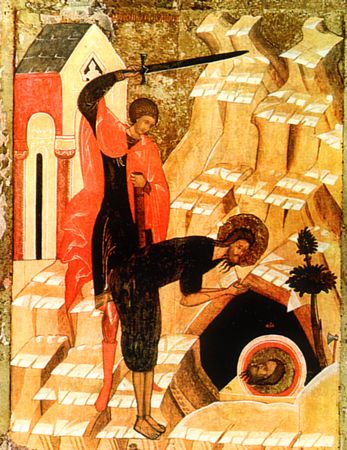
The core scene is the execution: the Forerunner kneeling or bowed forward, haloed, hands bound or extended, in the camel-hair melote, his neck bared; behind him the executioner in a short military tunic and red mantle, sword raised in both hands or already descending. The setting is rocky wilderness, often with the mouth of the prison-cave at one side. In the fully developed recension the same panel adds the severed head, sometimes lying in the cave, sometimes borne on the pinax by Salome; the banquet of Herod, a table under an architectural loggia with the tetrarch and Herodias reclining; and the dance, the girl bent backwards in the acrobatic pose that Byzantine art gives to dancers. Some recensions add the burial of the body by the disciples, and a few — the theologically boldest — set the Forerunner's soul or his figure among the dead at the gates of Hades, joining this icon to the Anastasis.
Two conventions are worth naming because they identify the subject decisively. The first is the doubling of the Forerunner within one icon: he appears both alive and kneeling, and again as a head on the platter, in the same field — a frank medieval simultaneity that a modern eye misreads as two saints. The second is that his physiognomy is the most fixed in the whole canon — emaciated, wild dark hair, long dishevelled beard — so that the head on the charger is recognisable as his even without an inscription. Greek panels are inscribed Η ΑΠΟΤΟΜΗ ΤΟΥ ΠΡΟΔΡΟΜΟΥ, Slavonic ones Усѣкновенїе главы Іѡанна Предтечи. Beside the narrative type stands the great devotional type that grew out of it, the winged Angel of the Desert contemplating his own head in a dish — treated with the Forerunner's portrait icons in his own entry rather than here.
The stored primary image is a Russian panel of the last quarter of the fifteenth century, of the northern school, in the Kyiv Museum of Russian Art. Its identity is not in doubt on inspection: the executioner stands at the left in a scarlet mantle over a dark tunic, the long sword swung back above his head in both hands; the Forerunner kneels at the centre, haloed, bowed forward with the neck offered and one hand reaching out; and at the lower right, in the black mouth of a cave among the schematic white-lit crags, lies the severed head with its halo, so that the icon shows the same saint twice in the one field. The architecture of the prison closes the left edge, and an inscription runs along the upper border. It is the classical short recension of the type, pared to the essential three elements.
The variant is a signed Cretan panel of 1590 by Michael Damaskinos, in the Municipal Gallery of Corfu — the same subject in the full Italo-Cretan idiom, signed and dated along the lower edge (the painter's signature ΧΕΙΡ ΜΙΧΑΗΛ ΔΑΜΑΣΚΗΝΟΥ at the right, the year in Greek numerals at the left). Here the Forerunner has already been struck: he sinks forward across the foreground rocks, haloed, the head still on the shoulders and the blood running, while a heavily armoured executioner in a plumed helmet raises the blade for the stroke; a second soldier in a crested Roman helmet stands at the right; Salome waits at the left in a pink court dress with the golden charger already held out; and above, under a gold ground half lost to abrasion, Herod's banquet proceeds on a marble loggia while angels descend from the upper corner with a cloth to receive the soul. It is a good example of what the Cretan school did with a Byzantine narrative type in the age of Venetian rule: the composition is still the tradition's, the anatomy and armour are Italian.
Disputed questions
- Whose daughter, and what was her name? Mark 6:22 in the majority of manuscripts reads "the daughter of the said Herodias"; a strong early group (including Sinaiticus and Vaticanus) reads "his daughter Herodias," which would make the dancer Antipas's own child and give her her mother's name. The Gospels never name her. Josephus names Herodias's daughter by her first husband Salome, and the whole tradition, East and West, has taken the dancer to be she. This entry follows the tradition and notes the textual problem.
- Which brother was Herodias's first husband? Mark and Matthew call him Philip; Josephus calls him Herod (son of Herod the Great by Mariamne II, often distinguished by moderns as Herod II or Herod Boethus) and reserves the name Philip for the tetrarch of Ituraea who later married Salome. Either the evangelists use a second name that Josephus does not record — the Herods bore several apiece — or one of the two sources has confused the brothers. No resolution is asserted.
- The place of the execution. The Gospels say only "in the prison." Josephus names Machaerus, and the tradition has followed him. A minority of modern writers have argued for Tiberias, on the ground that the banquet of Mark 6:21 is a court occasion attended by "the chief estates of Galilee" and Machaerus lay in Perea; against this, Machaerus was itself a palace as well as a fortress, and Perea was Antipas's territory too.
- The year. The synaxarion gives AD 32, reckoning from the Nativity; the Gospel sequence places the death shortly before the feeding of the five thousand, and Josephus before AD 36. Any year from about 29 to 32 satisfies the evidence.
- Is John a martyr? He died before the Cross and not for the confession of the name of Christ, but for the law of God. The tradition has never hesitated: the litia sticheron of Germanos the Patriarch names him "a martyr, for thy head was cut off for Christ's sake," and the day is served as a martyr's feast with a fast. This repository types him [prophet, martyr] in his own entry, and notes there that the title protomartyr is nevertheless reserved by the tradition for Stephen and never applied to John.
- The liturgical colour. The Greek books point to white: the great litia sticheron directs that we keep the Beheading λευχειμονοῦντες, "robed in white," rejoicing as on a day of festival. Slavic practice more often uses red, as for a martyr, or dark red in view of the fast. The saint's entry in this repository states red; the entry's record here follows the Menaion's own word. The divergence is flagged rather than harmonised.
- Which is the Forerunner's principal day? This repository's files do not agree: the Nativity and the saint's entry rank June 24 primary, while the Synaxis argues for January 7. The case for August 29 is stated under Feast and commemoration below. The question is logged at the project's record of open questions and awaits one decision applied across all six files.