
Peter the Apostle
The Holy, Glorious and All-Praised Chief Apostle Peter
Apostle · Martyr · b. Bethsaida of Galilee, early 1st century; son of Jonah, brother of Andrew — d. c. 67 at Rome (c. 64–68 in the sources), crucified head downward under Nero
Commemorated 16 January — Veneration of his precious chains, 29 June — Martyrdom at Rome, kept jointly with the Apostle Paul as the feast of the Chief Apostles, 30 June — Synaxis of the Holy Twelve Apostles
Peter — Simon bar Jonah, the fisherman of Bethsaida whom Christ renamed Cephas, "rock" — is the first-named of the Twelve, the prōtokoryphaios or "chief" of the apostolic choir, the confessor of Caesarea Philippi and the shepherd of the Lord's sheep. His life holds together the two poles of Christian experience with unusual frankness: the man who walked on water and sank, who confessed the Christ and was called Satan in the same chapter, who swore he would die with his Master and denied him three times before a servant girl, and who was restored beside the same charcoal fire by a threefold "Lovest thou me?" After Pentecost he preached the first Christian sermon, opened the door of the Church to the Gentiles in the house of Cornelius, was by ancient tradition the first to sit in the see of Antioch, and ended at Rome under Nero, crucified — at his own asking, so the tradition runs — with his head downward, about the year 67. The Church keeps his memory on June 29 together with Paul, and his witness is confessed daily in the Creed's "one holy, catholic and apostolic Church."
.jpg)
Origins and early life
He was born Simon (Hebrew Šimʿon; the Greek of the New Testament gives both Σίμων and, in the older Semitic form, Συμεών), son of a man called Jonah or John, in Bethsaida on the north shore of the Lake of Galilee (John 1:44). His brother was Andrew, the Protokletos. By trade he was a fisherman in partnership with the sons of Zebedee (Luke 5:10), and by the time of the Gospel narrative he had moved his household to Capernaum, where he owned a house and where his mother-in-law lay sick of a fever (Mark 1:29–31) — the plain evidence, kept in the Church's memory without embarrassment, that Peter was a married man. Paul appeals to the fact in argument: "Have we not power to lead about a sister, a wife, as well as other apostles, and as the brethren of the Lord, and Cephas?" (1 Cor. 9:5). Clement of Alexandria preserves the tradition that Peter's wife also suffered martyrdom, and that he called out to her by name as she was led away, bidding her "Remember the Lord."
He was, by the estimate of the Sanhedrin, an "unlettered and ordinary man" (Acts 4:13) — not illiterate, but without the rabbinic schooling that Paul had. He spoke Aramaic with the accent of Galilee, which is what betrayed him in the high priest's courtyard (Matt. 26:73). Before the call he was already among the seekers: Andrew was a disciple of the Forerunner, and it was Andrew who first found the Messiah and then "findeth his own brother Simon."
The call and the new name
The Fourth Gospel gives the first meeting: Andrew brings his brother, and Christ, looking upon him, says, "Thou art Simon the son of Jona: thou shalt be called Cephas" — which the evangelist glosses for his Greek readers, "which is by interpretation, A stone" (John 1:42). Kepha is Aramaic for rock; the Greek Πέτρος renders it. The name is not a description of the man's character, which was anything but rocklike in those years, but a vocation laid on him in advance.
The Synoptic call comes later and by the lake: "Follow me, and I will make you fishers of men" (Matt. 4:19), and in Luke's fuller telling after the draught of fishes that broke the nets, when Simon fell down at Jesus' knees crying, "Depart from me; for I am a sinful man, O Lord" (Luke 5:8). That cry is the key to the whole life. Peter's sanctity is never the sanctity of the unbroken; it is the sanctity of a man who knows exactly what he is and clings to Christ anyway.
From that point he stands first in every list of the Twelve — Matthew is explicit: "the first, Simon, who is called Peter" (Matt. 10:2) — and he belongs with James and John to the inner three admitted to the raising of Jairus' daughter, to the Transfiguration on Tabor, and to the agony in Gethsemane.
Walking on the water
After the feeding of the five thousand the disciples' boat was labouring in the fourth watch of the night, and Christ came to them walking on the sea. It is Peter who answers: "Lord, if it be thou, bid me come unto thee on the water." He came down, and he walked; and then "he saw the wind boisterous," was afraid, and began to sink, crying "Lord, save me" (Matt. 14:28–31). The Lord's hand caught him at once, with the reproach, "O thou of little faith, wherefore didst thou doubt?"
The Fathers read the episode as the pattern of the Christian life: the walking is possible only while the eyes are on Christ, and the sinking begins the instant they turn to the wind. Peter is the only one who asked to come, and the only one who sank — and the Church has always understood that these two facts belong together.
The confession at Caesarea Philippi
At the springs of the Jordan under Mount Hermon, in the pagan city Philip had named for Caesar, Christ asked, "Whom do men say that I the Son of man am?" and then, "But whom say ye that I am?" Simon Peter answered: "Thou art the Christ, the Son of the living God." And Jesus said, "Blessed art thou, Simon Bar-jona: for flesh and blood hath not revealed it unto thee, but my Father which is in heaven. And I say also unto thee, That thou art Peter, and upon this rock I will build my church; and the gates of hell shall not prevail against it. And I will give unto thee the keys of the kingdom of heaven" (Matt. 16:13–19).
This is the Gospel appointed at the Liturgy of June 29, and it is the passage on which a millennium of controversy turns; the Orthodox reading of "this rock" is set out under Disputed questions below. What must be said here is that the same chapter, only six verses later, has Peter taking the Lord aside to rebuke him for speaking of the Cross, and hearing in reply, "Get thee behind me, Satan: thou art an offence unto me" (Matt. 16:23). No evangelist places the confession and the rebuke so close together by accident. The Church that reads the one reads the other in the same breath.
Denial and restoration
At the Supper, when the Lord foretold that all would be offended, Peter protested, "Though all men shall be offended because of thee, yet will I never be offended," and was told that before the cock crew he would deny his Master three times. He answered, "Though I should die with thee, yet will I not deny thee" (Matt. 26:33–35). Luke preserves a word spoken to him alone: "Simon, Simon, behold, Satan hath desired to have you, that he may sift you as wheat: but I have prayed for thee, that thy faith fail not: and when thou art converted, strengthen thy brethren" (Luke 22:31–32). The commission is given in the same sentence as the warning of the fall.
In Gethsemane he slept, and then drew the sword and struck off the ear of Malchus, and was told to put it up. He followed "afar off" into the courtyard of the high priest, warmed himself at the charcoal fire among the servants, and there — to a doorkeeper, to a maid, to a kinsman of Malchus — denied that he knew the man three times, the third time with oaths. Then the cock crew. "And the Lord turned, and looked upon Peter... And Peter went out, and wept bitterly" (Luke 22:61–62). An old tradition, repeated in the synaxaria, says that he wept at every cockcrow for the rest of his life, and that the tears furrowed his cheeks.
The restoration is given by John alone, on the shore of Tiberias after the Resurrection, over another charcoal fire — the same rare word (ἀνθρακιά) that John used of the courtyard, and no reader in the ancient Church missed the echo. Three times the Lord asks, "Simon, son of Jonas, lovest thou me?"; three times Peter answers; three times he is given a charge — "Feed my lambs," "Shepherd my sheep," "Feed my sheep" — one for each denial. And then the prophecy of the end: "When thou wast young, thou girdedst thyself, and walkedst whither thou wouldest: but when thou shalt be old, thou shalt stretch forth thy hands, and another shall gird thee, and carry thee whither thou wouldest not." "This spake he," the evangelist adds, "signifying by what death he should glorify God" (John 21:15–19). The Church reads this Gospel at the Matins of June 29 and at the January 16 feast of the Chains.
Pentecost and the Church at Jerusalem
Between the Ascension and Pentecost it is Peter who stands up among the hundred and twenty and proposes the filling of Judas' place (Acts 1:15–22). On the day of Pentecost it is Peter who "stood up with the eleven" and preached the first sermon of the Christian era, ending, "God hath made that same Jesus, whom ye have crucified, both Lord and Christ" — and three thousand were baptised (Acts 2:14–41). The unlettered Galilean of the courtyard is unrecognisable; the Church has always seen in the change the plainest proof of Pentecost.
The Jerusalem chapters of Acts are largely his: the healing of the lame man at the Beautiful Gate and the sermon in Solomon's porch; the twofold arrest and the answer to the Sanhedrin, "We ought to obey God rather than men"; the judgement on Ananias and Sapphira; the sick laid in the streets that at least the shadow of Peter passing by might fall on some of them (Acts 5:15); the rebuke of Simon Magus in Samaria, from whose attempt to buy the gift of the Spirit the Church's word simony comes; the healing of Aeneas at Lydda and the raising of Tabitha at Joppa. And it is at Joppa, in the house of Simon the tanner, that the vision of the great sheet came down.
Cornelius, and the opening to the Gentiles
The tenth chapter of Acts is the hinge of the apostolic age, and Peter is the man in the door. Three times the sheet of unclean beasts descends and the voice says, "Rise, Peter; kill, and eat"; three times he refuses, and is told, "What God hath cleansed, that call not thou common." While he is still perplexed the messengers of the centurion Cornelius arrive from Caesarea. He goes with them — a Jew entering a Gentile house — and preaches; and while he is still speaking, "the Holy Ghost fell on all them which heard the word," and the astonished Jewish believers who had come with him hear Gentiles speaking with tongues. Peter's conclusion is a question no one could answer: "Can any man forbid water, that these should not be baptized, which have received the Holy Ghost as well as we?" (Acts 10:47).
Called to account for it at Jerusalem, he rehearsed the whole vision and ended, "What was I, that I could withstand God?" — and the objectors "held their peace, and glorified God" (Acts 11:1–18). Everything that follows in the history of the Church, including the mission of Paul, stands on that decision.
Between these events falls the arrest by Herod Agrippa I at the Passover in which James the son of Zebedee was beheaded: Peter bound with two chains between two soldiers, the angel in the prison, the chains falling from his hands, the iron gate opening of its own accord, and the servant Rhoda too glad to open the door of the house of Mary the mother of Mark (Acts 12:1–17). Those fetters are themselves a feast of the Church: see the Veneration of the Precious Chains, January 16. Luke ends the episode with a sentence that has been argued over ever since: "and he departed, and went into another place."
Antioch
The Antiochian tradition takes that "other place" to be, in time if not immediately, Antioch on the Orontes — the third city of the Empire, the base of the Gentile mission, and the place "where the disciples were first called Christians" (Acts 11:26). That Peter was in Antioch is not a matter of later legend but of Paul's own testimony: "when Peter was come to Antioch, I withstood him to the face" (Gal. 2:11). The ancient episcopal lists make him the founder of that church and its first bishop, with Evodus as his successor and Ignatius the God-bearer after him; the length of seven years given by later Western sources is a schematic figure, but the succession itself is attested by Eusebius, Origen and the whole Syrian memory. The See of Antioch has never ceased to call itself the see of Peter, and the Western calendar's separate feast of the Chair of Peter at Antioch (February 22) is a survival of the same conviction in Rome. It is worth saying plainly, in a reference compiled from the Antiochian tradition, that the argument from Peter's presence proves at least as much for Antioch as for Rome, and that this is one reason the Orthodox East has never been able to read the Petrine texts as the charter of a single see.
The incident at Antioch (Gal. 2:11–14) is the more remarkable for it. Peter had eaten freely with the Gentile converts; then "certain came from James," and he "withdrew and separated himself, fearing them which were of the circumcision," and Barnabas with him. Paul confronted him publicly: "If thou, being a Jew, livest after the manner of Gentiles, and not as do the Jews, why compellest thou the Gentiles to live as do the Jews?" The Fathers who comment on the passage — Chrysostom above all, preaching in Antioch itself — are careful to say that this was no schism between apostles and no doctrinal quarrel: Peter had already settled the question in Cornelius' house and would state it again at the Council; his fault was pastoral timidity, and Paul's rebuke was the office of a brother, not of a judge. Chrysostom goes further and reads the scene as a deliberate arrangement between them for the sake of the onlookers, which is a homiletic softening; Jerome followed him, and Augustine objected, and the exchange between Jerome and Augustine on the point is one of the great correspondences of Christian antiquity. What the Orthodox tradition has never done is to treat the incident as embarrassing. That the chief of the apostles could be withstood to the face, and take it, is part of what the Church means by apostolic collegiality.
The Council of Jerusalem
About the year 49 the question forced by Cornelius came to a head. At the Council recorded in Acts 15 — the pattern and warrant of every council since — Peter rose after much disputing and gave the decisive testimony: God had put no difference between Jew and Gentile, "purifying their hearts by faith"; why then "tempt ye God, to put a yoke upon the neck of the disciples, which neither our fathers nor we were able to bear?" (Acts 15:7–11). The assembly fell silent, heard Barnabas and Paul, and then heard James the Brother of the Lord, the bishop of the city, pronounce the sentence — "Wherefore my sentence is..." — which the apostles, elders and whole church then issued in the letter beginning "It seemed good to the Holy Ghost, and to us." Orthodox readers have always noticed the shape of that proceeding: Peter speaks first and decisively, the local bishop presides and formulates, and the decree goes out in the name of the whole body.
The epistles
Two catholic epistles bear Peter's name. 1 Peter is addressed to the churches of Pontus, Galatia, Cappadocia, Asia and Bithynia — the northern arc of Asia Minor — and is a letter of consolation to Christians under social hatred: "Beloved, think it not strange concerning the fiery trial which is to try you." It gives the Church some of her most used phrases — "a chosen generation, a royal priesthood, an holy nation, a peculiar people"; "your adversary the devil, as a roaring lion, walketh about, seeking whom he may devour" — and the difficult and precious passage on the preaching to "the spirits in prison" (1 Pet. 3:19), which stands behind the whole Byzantine hymnography of the Descent into Hades. It is sent from "Babylon" (1 Pet. 5:13) — read by the ancient Church, and by nearly all readers since, as a cipher for Rome — with the greetings of "Marcus my son", that is Mark the Evangelist, whose Gospel Papias calls the record of Peter's own preaching, and by the hand of Silvanus.
2 Peter is shorter, sharper and more contested (see Disputed questions): a warning against false teachers and against the scoffers who ask, "Where is the promise of his coming?", with the great sentence on Scripture — "holy men of God spake as they were moved by the Holy Ghost" — and the first-hand claim to have been on the holy mountain and heard the voice.
Rome and the martyrdom
That Peter ended at Rome is among the best-attested facts of the sub-apostolic age. Clement of Rome, writing about the year 96 within living memory, names Peter and Paul together as the "greatest and most righteous pillars" who suffered in the persecution and "bore witness" (1 Clem. 5). Ignatius of Antioch, on his own way to the Roman arena about 107, writes to the Romans, "I do not command you as Peter and Paul did" (Rom. 4:3). By about 200 the Roman presbyter Gaius could offer to show a disputant "the trophies of those who founded this church" — Peter's at the Vatican, Paul's on the Ostian Way — and Irenaeus, Tertullian, Origen and Eusebius all take the Roman martyrdom as common knowledge. The excavations under the Vatican basilica in the twentieth century uncovered a second-century funerary monument, the aedicula answering to Gaius' "trophy," over a first-century grave in a pagan necropolis — which establishes the antiquity of the cult beyond doubt, whatever one concludes about the bones.
The manner of the death is given first by Origen, quoted by Eusebius: Peter "was crucified at Rome head downward, as he himself had asked to suffer" (Eusebius, Church History III.1). The apocryphal Acts of Peter, of the later second century, fills the scene out: the apostle, persuaded by the brethren to flee the persecution, meets Christ on the Appian Way going toward the city, asks "Quo vadis, Domine?" — "Lord, whither goest thou?" — and is told, "I go to Rome to be crucified again"; whereupon he turns back to his death. The same Acts supplies the mystical reason for the inverted cross, that the first man fell head downward into the world and the sign must be reversed; the synaxaria keep instead the simpler and more Petrine motive — that he did not count himself worthy to suffer in the same posture as his Lord. It is of a piece with "Depart from me, for I am a sinful man."
The date is placed in the Neronian persecution that followed the fire of Rome in July 64; the usual reckoning is c. 67, with a range of 64 to 68 in the sources. He was buried on the Vatican hill, where the basilica bearing his name now stands.
Feast and commemoration
Peter's feast is June 29 (Old Calendar civil July 12), kept jointly with the Apostle Paul as the feast of the Chief Apostles — see the feast entry for the history and rank of the day. It is one of the five great feasts of the fixed year outside the Twelve, served with an all-night vigil, and it closes the Apostles' Fast, which begins on the Monday after the Sunday of All Saints and so varies in length from a few days to six weeks according to the date of Pascha. In the Slavonic and Greek books alike the day has one office for both apostles; the OCA and several Greek sources also publish separate lives for Peter and for Paul under the same date, which is the practice followed in this collection.
He is commemorated again on January 16, the Veneration of the Precious Chains, and on June 30 with the Synaxis of the Holy Twelve Apostles — the morrow-synaxis by which the Byzantine rite regularly gathers the companions of a great feast (not yet authored in this repository). The Western calendar keeps two further Petrine days that the East does not: the Chair of Peter at Antioch (February 22) and the Chair at Rome (January 18), later combined. Innumerable churches and monasteries bear his name jointly with Paul, and in Antiochian and Greek usage the name-day of every Petros and Pavlos falls on June 29.
Hymns
Apolytikion — Tone 4
O first-enthroned among the Apostles and teachers of the inhabited world, intercede with the Master of all things to grant peace to the world and to our souls the great mercy.
Kontakion — Tone 2
The steadfast and God-inspired heralds, the chief of thy disciples, O Lord, thou hast taken to thyself for the enjoyment of thy good things and for rest; for their labours and their death thou hast received above every whole burnt offering, O thou who alone knowest the secrets of the heart.
Original translation from the Greek
Appointed readings
Epistle — 2 Corinthians 11:21–12:9
21I speak as concerning reproach, as though we had been weak. Howbeit whereinsoever any is bold, (I speak foolishly,) I am bold also. 22Are they Hebrews? so am I. Are they Israelites? so am I. Are they the seed of Abraham? so am I. 23Are they ministers of Christ? (I speak as a fool) I am more; in labours more abundant, in stripes above measure, in prisons more frequent, in deaths oft. 24Of the Jews five times received I forty stripes save one. 25Thrice was I beaten with rods, once was I stoned, thrice I suffered shipwreck, a night and a day I have been in the deep; 26In journeyings often, in perils of waters, in perils of robbers, in perils by mine own countrymen, in perils by the heathen, in perils in the city, in perils in the wilderness, in perils in the sea, in perils among false brethren; 27In weariness and painfulness, in watchings often, in hunger and thirst, in fastings often, in cold and nakedness. 28Beside those things that are without, that which cometh upon me daily, the care of all the churches. 29Who is weak, and I am not weak? who is offended, and I burn not? 30If I must needs glory, I will glory of the things which concern mine infirmities. 31The God and Father of our Lord Jesus Christ, which is blessed for evermore, knoweth that I lie not. 32In Damascus the governor under Aretas the king kept the city of the Damascenes with a garrison, desirous to apprehend me: 33And through a window in a basket was I let down by the wall, and escaped his hands. 1It is not expedient for me doubtless to glory. I will come to visions and revelations of the Lord. 2I knew a man in Christ above fourteen years ago, (whether in the body, I cannot tell; or whether out of the body, I cannot tell: God knoweth;) such an one caught up to the third heaven. 3And I knew such a man, (whether in the body, or out of the body, I cannot tell: God knoweth;) 4How that he was caught up into paradise, and heard unspeakable words, which it is not lawful for a man to utter. 5Of such an one will I glory: yet of myself I will not glory, but in mine infirmities. 6For though I would desire to glory, I shall not be a fool; for I will say the truth: but now I forbear, lest any man should think of me above that which he seeth me to be, or that he heareth of me. 7And lest I should be exalted above measure through the abundance of the revelations, there was given to me a thorn in the flesh, the messenger of Satan to buffet me, lest I should be exalted above measure. 8For this thing I besought the Lord thrice, that it might depart from me. 9And he said unto me, My grace is sufficient for thee: for my strength is made perfect in weakness. Most gladly therefore will I rather glory in my infirmities, that the power of Christ may rest upon me.
Gospel — Matthew 16:13–19
13When Jesus came into the coasts of Caesarea Philippi, he asked his disciples, saying, Whom do men say that I the Son of man am? 14And they said, Some say that thou art John the Baptist: some, Elias; and others, Jeremias, or one of the prophets. 15He saith unto them, But whom say ye that I am? 16And Simon Peter answered and said, Thou art the Christ, the Son of the living God. 17And Jesus answered and said unto him, Blessed art thou, Simon Bar-jona: for flesh and blood hath not revealed it unto thee, but my Father which is in heaven. 18And I say also unto thee, That thou art Peter, and upon this rock I will build my church; and the gates of hell shall not prevail against it. 19And I will give unto thee the keys of the kingdom of heaven: and whatsoever thou shalt bind on earth shall be bound in heaven: and whatsoever thou shalt loose on earth shall be loosed in heaven.
Iconography
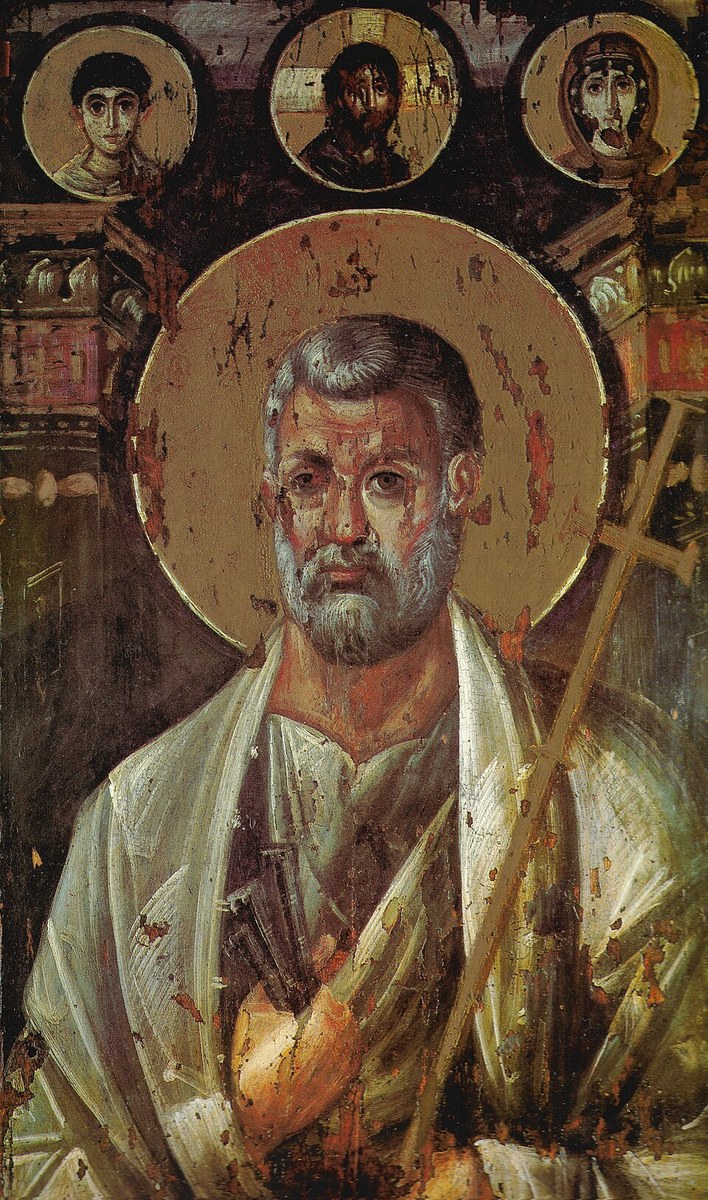
Peter is one of the two apostles whose face is fixed in Byzantine art beyond any variation: short, thick, grey or white curling hair and a short rounded beard, a broad and slightly worn face, ordinarily in a golden-ochre chiton and blue-green himation. He carries a scroll, and very often the keys of the Kingdom, sometimes a set of two or three on a ring; a cross-staff appears in the older panels as the mark of the apostolic preacher and the sign of his death. In the Deesis and apostle tiers of the iconostasis he stands nearest the Mother of God on Christ's right, with Paul balancing him on the left. Narrative scenes are many: the calling by the lake, the walking on the water, the washing of the feet, the denial with the cock, the deliverance from prison by the angel, the Descent of the Holy Spirit, and the martyrdom on the inverted cross. The classic joint image, the Embrace of the Apostles (Ἀσπασμὸς τῶν Ἀποστόλων), is described at the feast entry.
The stored image is the encaustic panel of St Peter at the Monastery of St Catherine on Sinai, of the sixth or seventh century — one of the small group of icons that survived the iconoclast destruction because Sinai lay outside the Empire, and among the oldest icons of any saint in existence. The apostle is shown bust-length and frontal, grey-haired and grey-bearded, holding a bunch of keys and a slender cross-staff, before an architectural niche; three medallions above carry Christ in the centre between a beardless young saint and a crowned figure. The technique is late-antique encaustic, continuous with the Fayum portraits, and the face is unmistakably the Peter of every later icon.
Disputed questions
"Upon this rock" (Matt. 16:18). The Orthodox tradition does not deny that Christ named Simon Kepha and that the wordplay of the verse is real; it denies the papal inference drawn from it. Three readings of "this rock" are found in the Fathers, and the Church has never treated them as mutually exclusive. The first, and the commonest in the East, takes the rock to be the confession just made: so John Chrysostom — "upon this rock," that is, upon the faith of the confession — and Ambrose, Hilary, Cyril of Alexandria, Theodoret and the Byzantine commentators after them; Theophylact says the Lord did not say "upon Peter," for he built the Church not upon the man but upon the faith. The second takes the rock to be Christ himself, "and that Rock was Christ" (1 Cor. 10:4) — Augustine's mature and much-quoted position in the Retractations, where he leaves the reader to choose. The third does take the rock to be Peter, and Orthodox writers have no need to suppress it: what they deny is that this yields a monarchy. If Peter is the rock, he is so as the confessor, and, in the words the East has repeated since Origen, every believer who makes his confession becomes Peter, and every bishop who holds his faith sits in his chair. Peter's own epistle draws exactly that conclusion for the whole people: "ye also, as lively stones, are built up a spiritual house" (1 Pet. 2:5). The keys, likewise, are given to Peter in Matthew 16 and to all the apostles in Matthew 18:18 and John 20:23, in the same words; the Council of Jerusalem, at which Peter speaks but James pronounces and the whole body decrees, shows the apostolic Church acting on that reading. And there is the plain fact of geography already noted: if the promise attaches to a place because Peter sat there, it attaches first to Antioch, and after Antioch to Rome. The Orthodox position is therefore not a diminishing of Peter but a refusal to make the Church's foundation a single episcopal office — stated here, as it should be, without polemic and without pretending the difference is small.
Petrine primacy. The East has always granted Peter a primacy and used the strongest language about it: he is koryphaios and prōtokoryphaios, "chief," "first-throned," "the mouth of the apostles" — the Byzantine service books are more extravagant on this head than most Western texts. What the East has never granted is that the primacy was an office of jurisdiction over the other apostles, transmissible to a single successor. The canonical tradition orders the sees by the taxis of Nicaea I (canon 6), Constantinople I (canon 3) and Chalcedon (canon 28), and those canons ground the rank of a see in the dignity of its city and the consent of the Church, not in a Petrine deed. Rome's primacy of honour among equals the Orthodox have never disputed; the universal jurisdiction and the personal infallibility defined at the First Vatican Council in 1870 they regard as a development without patristic warrant. The disagreement is real and it is old — but the feast of June 29 belongs equally to both communions, and Orthodox and Catholic keep it on the same day.
The date of the martyrdom, and whether the two died together. The tradition that Peter and Paul suffered on the same day is very old and universally received liturgically; whether they suffered in the same year was already disputed in antiquity. Eusebius and Jerome place both in the same persecution and, in effect, the same time; the Latin poet Prudentius, writing about 400, says explicitly that a full year separated them, Peter's cross and Paul's sword falling on the same date twelve months apart; some Greek sources give a difference of a year the other way. A further complication is the date itself. The Roman Depositio Martyrum of the Chronograph of 354 enters under 29 June — III kalendas Iulias — the deposition of Peter in the Catacombs and of Paul on the Ostian Way, in the consulate of Tuscus and Bassus, that is 258, nearly two centuries after the martyrdoms. Many historians therefore hold that June 29 preserves the date of a translation of the relics during the persecution of Valerian rather than the date of death; others hold that 258 is the year the entry was compiled and the day itself older memory. Nothing in the Church's keeping of the feast depends on the answer, and the synaxaria are content to say that the two are honoured together because their labour, their city and their crown were one.
The authorship of 2 Peter. Eusebius classes the second epistle among the antilegomena, the books "spoken against" — not rejected, but not received everywhere — and notes that it was not in his judgement part of the covenanted canon, though it was studied with the other Scriptures (Church History III.3, III.25). Jerome records the ancient observation that its style differs markedly from that of 1 Peter and repeats the explanation that Peter used different secretaries. The epistle was received without further question by the fourth century and stands in the canon of the Orthodox Church. Modern critical scholarship widely regards it as pseudonymous; the Church's judgement rests on its reception, and the disagreement is recorded here rather than resolved.
The twenty-five years at Rome. Jerome (De viris illustribus 1) says Peter came to Rome in the second year of Claudius (42) and held the see twenty-five years. The figure cannot be reconciled with Acts, which has Peter in Jerusalem in the mid-40s and at the Council in 49, nor with Galatians, which has him at Antioch after that, nor with Romans, whose long list of greetings in the late 50s never mentions him. The Orthodox tradition has no stake in the number; that Peter came to Rome, taught there and died there is what the sources support.